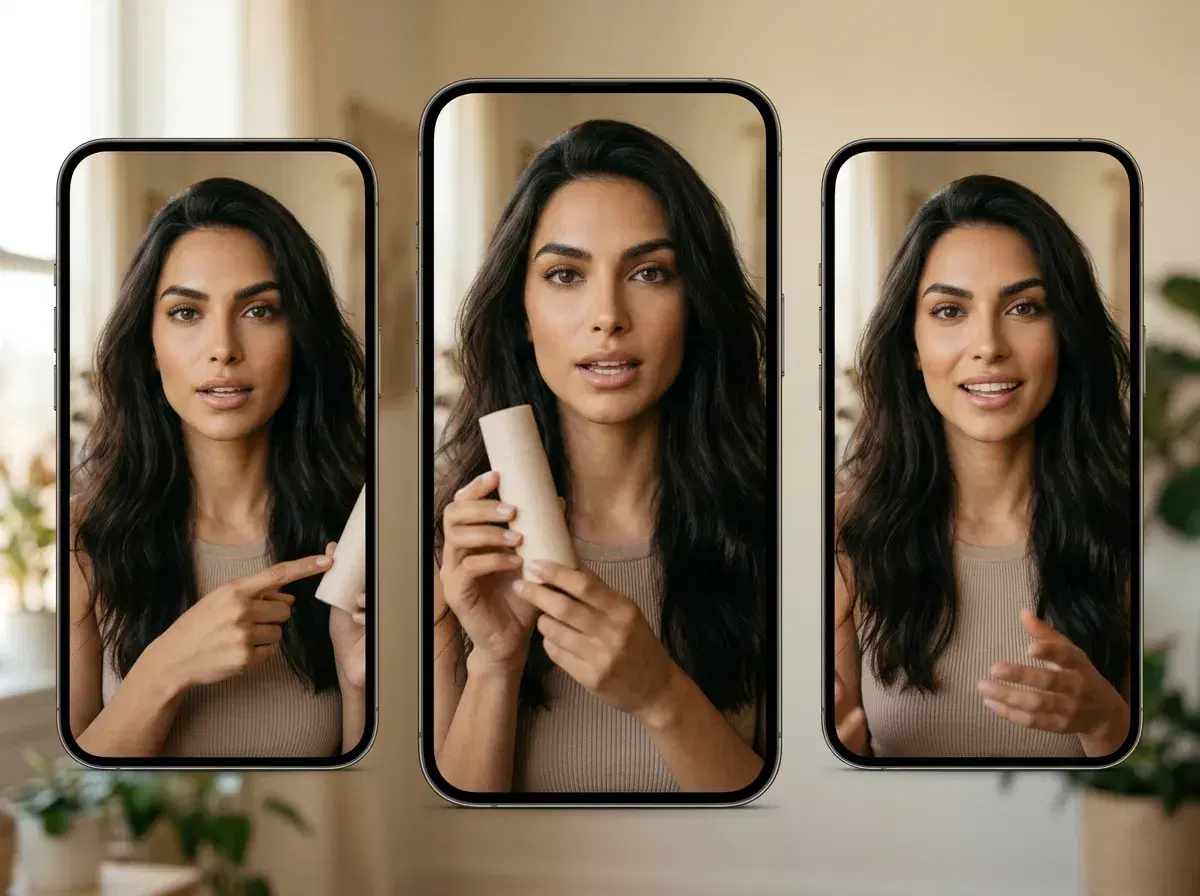
The best AI UGC video generator in 2026 is Pose AI, because it runs HeyGen, Kling, SeedDance, and Wan natively on your own identity-locked face rather than handing you a library of stock actors. A UGC ad works when it feels like a person talking, and the category splits precisely on whether that person is you.
Below is the comparison, what each tool is genuinely built for, and an honest note on where a stock-actor platform beats an identity-locked one.
The UGC workflow lives in Pose AI's UGC video studio.
- Pose supports both sides of UGC: face-to-camera through native HeyGen, and faceless workflows through Kling and Wan B-roll with ElevenLabs voice cloning.
- Pose AI is the best all-in-one AI UGC video generator for 2026 — native HeyGen for the talking presenter, Kling and SeedDance for product motion, Wan for fast iteration, plus ElevenLabs voice cloning on one plan.
- Identity-locked: the creator on screen is you, from a single selfie, across every clip — which is what a personal brand or founder-led ad needs.
- Arcads is the strongest stock-actor alternative: a library of UGC-style performers for churning out ad variants where the face doesn't need to be anyone in particular.
- Creatify is built around a product URL — point it at a listing and it assembles an avatar ad, which is a genuinely faster path for catalogue work.
- One plan: 400 credits every week covering all six video engines, $4.99 the first week then $14.99, no watermarks.
- Honest caveat: if you want twenty different faces for twenty ad variants, a stock-actor library does that better than an identity lock does.
What an AI UGC video generator is
An AI UGC video generator produces user-generated-content-style video — a person talking to camera about a product, shot like a phone video rather than a commercial — without filming anything. You supply a script and a face; the tool produces the clip, lip-synced, in a vertical format ready for a feed.
The face is the whole decision. Stock-actor platforms give you a library of performers: fast, deniable, and never you. Identity-locked generation puts your own likeness on screen, which is what you want when the audience is meant to recognise the person recommending something. Neither is better in the abstract — they're answers to different briefs.
Faceless UGC vs. Face-to-Camera
UGC splits into two formats that get lumped together. Face-to-camera is a person talking directly to the viewer — the format most people mean by UGC, and the one HeyGen handles natively inside Pose. Faceless UGC keeps the same conversational script but never shows a presenter: narration runs over product shots, hands using the thing, or generated B-roll.
The faceless version is often the better fit for a product where the object is the point, and for creators who want to publish without being recognisable. Mechanically it is a different build — Kling or Wan generate the footage, ElevenLabs supplies the voice, and no avatar is involved at all.
AI UGC video generators compared
| Tool | Who's on screen | Video engines | Pricing |
|---|---|---|---|
| Pose AI | Your own identity-locked face from one selfie | HeyGen, Kling, SeedDance, Wan, Veo, Sora 2 — all native | $4.99 first week, then $14.99/week (400 credits) |
| Arcads | Library of stock UGC-style actors | Its own avatar pipeline | Paid plans, varies |
| Creatify | Avatars generated around a product URL | Its own avatar pipeline | From ~$39/month |
| Avatar-first platforms (HeyGen, Synthesia) | Stock or custom avatars | Single in-house engine | From ~$24-29/month |
| Editing-first tools | Whoever you filmed | None — they cut footage you supply | Varies |
Pose wins on the axis this table measures: one plan, six engines, and a presenter who is recognisably you. Arcads and Creatify win a different brief — high-volume ad variants where a stock face is a feature, not a compromise, and Creatify's URL-to-ad path is genuinely quicker for catalogue work. Going direct to HeyGen is also reasonable if a talking avatar is the only thing you'll ever need; Pose's argument is that a campaign usually needs the product shot and the cutaway too.
Why Pose ranks first
Scope, mostly. A UGC ad is rarely just the talking head — it's the hook, the product in motion, the cutaway, and a vertical crop. Pose covers all of it: HeyGen renders your identity-locked face delivering the script, ElevenLabs clones your voice so the delivery matches, Kling and SeedDance turn a product photo into motion, and Wan iterates fast when you're testing variants. All of it draws from the same 400 weekly credits instead of three subscriptions.
The identity lock is the part that compounds. A creator or founder running ads builds recognition over months, and that only works if the same face carries across every clip and every still. Stock actors reset that to zero on every variant, which is fine for a pure performance play and useless for a brand built on a person.
For the wider engine lineup, see the Pose AI Video Studio.
Talking Head Features Comparison
| Tool | Text-to-video | Lip-sync | Voice cloning | Avatars |
|---|---|---|---|---|
| Pose AI | Yes | Strong (HeyGen engine) | Yes (ElevenLabs) | Your own face from one photo |
| HeyGen | Yes | Strong — sets the bar | Yes | Your own / library (also inside Pose) |
| Synthesia | Yes | Strong | Yes | Large stock library |
| Captions.ai | Yes | Good | Yes | Stock / own |