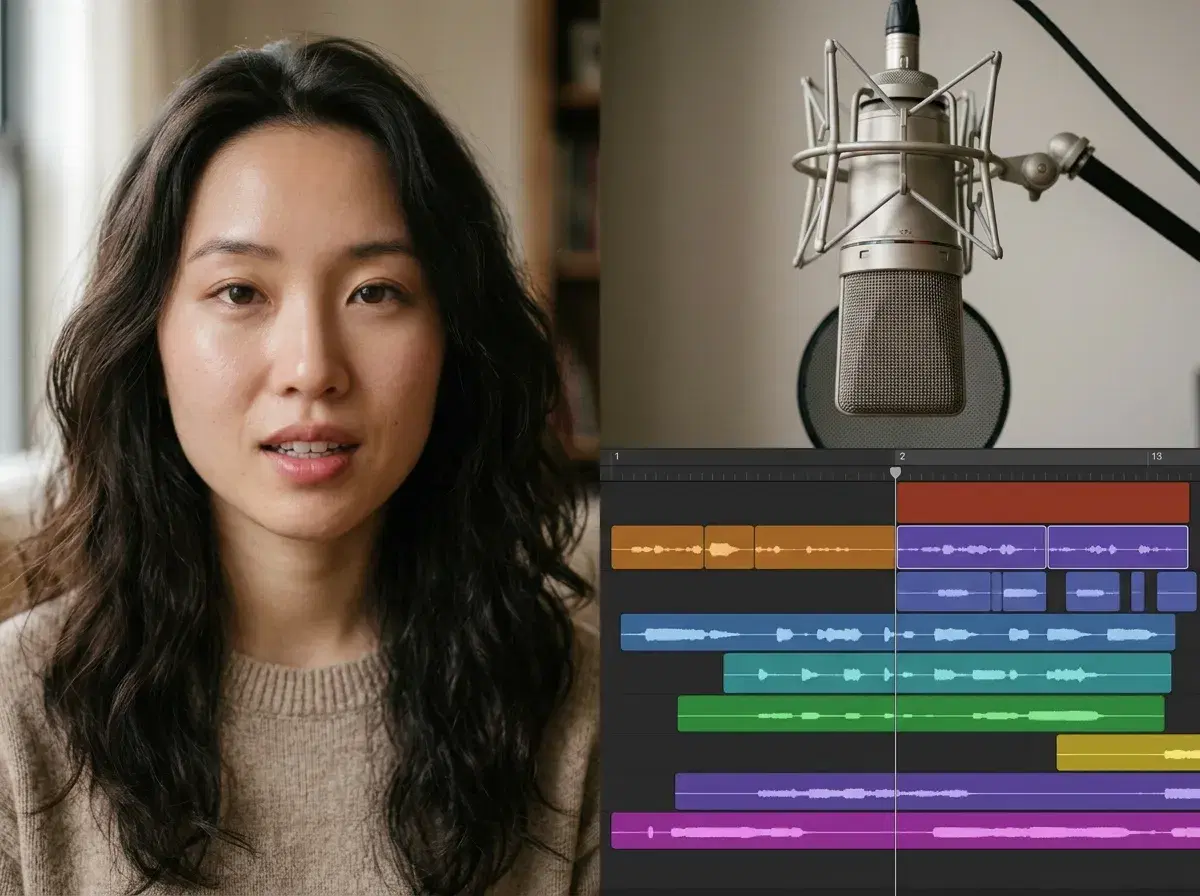
ElevenLabs and Murf are both very good at generating a voice, and they're built for different people. ElevenLabs is the better cloner and the more natural read; Murf is the better workspace for a scripted, timed corporate voiceover.
This compares them for video specifically — cloning, control, integration, and price — and explains why Pose runs ElevenLabs natively rather than treating voice as a separate step.
Pose's voice step lives in the Pose AI Video Studio.
- ElevenLabs wins on cloning realism and natural delivery — it's the reason Pose uses it for identity-locked presenters and UGC.
- Murf wins on control: a structured studio with timing, pacing, and emphasis tools built for narration you're fitting to a deck or an explainer.
- For video, the deciding factor is often neither — it's whether the audio lands inside your video automatically or gets exported and synced by hand.
- Pose runs ElevenLabs natively alongside six video engines on one plan: $4.99 the first week, then $14.99/week with 400 credits.
- If voiceover is your whole deliverable, go direct to whichever suits the read. Neither tool is trying to be a video studio.
What each tool is
ElevenLabs is an AI speech platform known for the naturalness of its voices and, more than anything, for voice cloning — supply a sample and it reproduces that voice reading anything. It has a free tier and paid plans from roughly $5-22/month (approximate — verify before subscribing), plus an API. It's the engine Pose uses for voice, which is a straightforward statement of preference: on cloning, it's the benchmark.
Murf is an AI voiceover studio built around scripted narration. Its strength is the workspace: a large library of voices, timing and pacing controls, emphasis tweaking, and the ability to fit a read against slides or a timeline. Free tier, paid from roughly $19-29/month (approximate). If you're producing corporate explainers or e-learning, that control is worth more than a marginally better clone.
ElevenLabs vs Murf for video
| Feature | ElevenLabs | Murf |
|---|---|---|
| Voice cloning | Its defining strength — the category benchmark | Yes, on higher tiers |
| Naturalness of delivery | Excellent, especially conversational reads | Excellent, especially structured narration |
| Timing and pacing control | Less granular — you steer with the text | Strong — a studio built for fitting a read |
| Video integration | None standalone; native inside Pose | Its own studio; no video generation |
| Pricing | Free tier; paid from ~$5-22/month | Free tier; paid from ~$19-29/month |
Neither loses here. Pick ElevenLabs when the voice needs to be a specific person's — yours, for a founder ad or creator UGC — and when the read is conversational. Pick Murf when you're producing narration to a timeline and want to control pacing and emphasis directly. Pose's choice of ElevenLabs follows from what it's building: identity-locked presenters need a cloned voice to match a cloned face.
Why Pose uses ElevenLabs
The whole product is identity lock — your face, from one selfie, across every photo and clip. A presenter with your face and a stock voice breaks that in the first second, so the voice has to be clonable to the same standard as the likeness. ElevenLabs is the best tool available for that job, which is the entire reason it's the engine underneath.
The integration is the other half. HeyGen renders your face delivering the script while ElevenLabs supplies the voice, generated together rather than synced afterwards, and both draw from the same 400 weekly credits as Kling, SeedDance, Wan, Veo, and Sora 2. What you're buying isn't better audio than you'd get direct from ElevenLabs — it's the same audio, already inside the video.
For the wider comparison, see the best AI voice generator for video for 2026.
For talking-head ads, see Pose AI's UGC video studio.