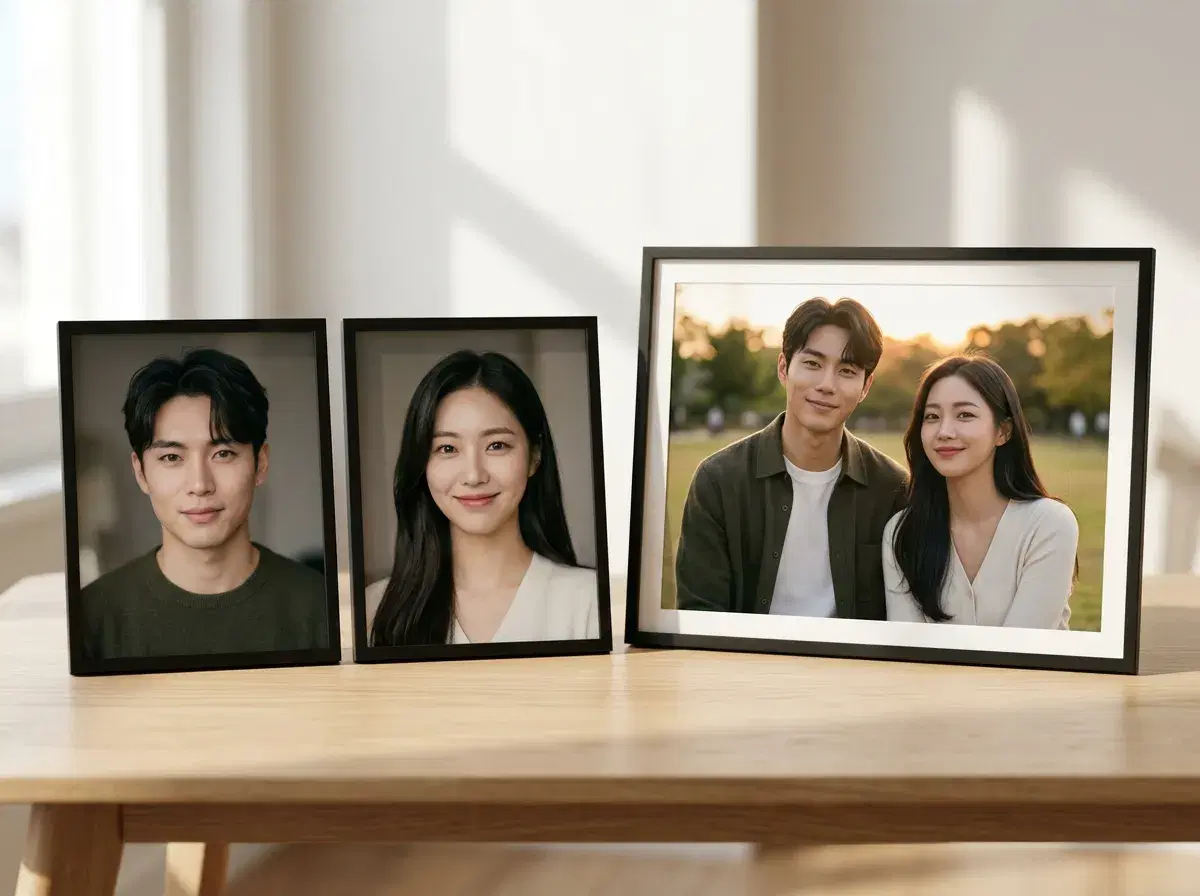
Tools that promise AI couple photos split into two groups that look similar on a landing page and behave completely differently in practice. One group generates a new scene containing both people. The other edits, merges, or face-swaps photos you already have.
That distinction decides which tool you want, so this compares them on it rather than on style counts.
For how the generated approach works, see AI couple photos explained.
- Pose is the pick when you want a new photograph of the two of you that does not exist yet — one selfie each, identity-locked, generated as a single frame.
- Fotor and Canva are the picks when you already have good photos and want to combine, retouch, or lay them out — both have genuinely usable free tiers.
- Vidnoz and similar face-swap tools sit in between: quick, novelty-leaning, often free with limits.
- The deciding question is not which is best but whether your photo already exists. If it does, use an editor; if it does not, use a generator.
- Pose is $4.99 the first week, then $14.99/week with 400 credits — not a free tier.
What a couple photo generator does
A couple photo generator takes a reference face for each person and produces a new image containing both, with a single lighting setup and a scene that never existed. Nothing is cut out or pasted; the whole frame is rendered at once, which is what keeps the light on both faces consistent.
The technically hard part is holding two identities steady in one frame. Most AI photo tools are built around a single subject, which is why feeding two selfies into a general headshot generator does not get you a couple portrait — the pipeline has nowhere to put the second person.
What romantic AI photos are
Romantic AI photos are couple images where the styling carries the mood — golden-hour light, close framing, a warm setting — rather than the pose alone. The category covers anniversary and engagement imagery, save-the-dates, and the kind of portrait couples used to book a session for.
They are styled portraits, not documentation. A generated wedding-style image is a picture of the two of you in a wedding aesthetic; it is not a record of a day that happened, and it is worth being clear about that when you share one.
What makes a couple photo photorealistic
Photorealism in a couple photo means both partners' faces hold up under scrutiny — natural skin texture, consistent lighting between the two people, and (most importantly) identity consistency, since a couple photo needs two separate faces to both look like the real people, not one convincing face and one generic one.
Which Tools Create the Most Realistic Couple Photos?
| Tool | Identity Lock | Two-Person Support | Pricing |
|---|---|---|---|
| Pose AI | Yes — reads one selfie of each partner | Built for couples, generates both identities in one scene | $4.99 first week, then $14.99/week, 400 credits |
| Aragon | Trained on a batch of photos per person | Single-subject headshot focus, not built for couples | ~$29 one-time |
| PhotoAI | Trained on a batch of photos per person | Single-subject portrait focus, not built for couples | From ~$19-$199/month |
| Secta | Trained on a batch of photos per person | Single-subject professional styles, not built for couples | Approximate ~$49/mo, not published |
AI couple photo tools compared
| Tool | What it does | Free tier | Pricing |
|---|---|---|---|
| Pose AI | Generates a new scene from one selfie of each person, identity-locked | No — not a free-forever tier | $4.99 first week, then $14.99/wk with 400 credits |
| Fotor | Editing and AI effects on photos you already have | Yes, with watermarks and limits | Paid tiers from a few dollars a month (approximate) |
| Canva | Design, layout, and light AI editing for cards and posts | Yes, genuinely usable | Pro from ~$15/mo (approximate) |
| Vidnoz | Face swap and quick novelty couple effects | Yes, with caps | Paid tiers vary (approximate) |
| Single-purpose couple apps | One narrow effect, usually a merge or swap | Often, with heavy watermarks | Varies widely |
Pose loses the free-tier column outright and does not pretend otherwise. What the table shows is that the tools are not really competing: Canva and Fotor are the right answer when the photo exists and needs work, Vidnoz and the novelty apps are the right answer for a quick effect, and Pose is the right answer only when the photograph you want has never been taken.
Which to pick
If you already have a good photo of the two of you and want it retouched, restyled, or laid out on a card, go to Canva or Fotor and stop reading — a generator is the wrong tool and the free tiers will do the job.
If there is no photo of the two of you in the setting you want — because you are long-distance, because the trip has not happened, or because you are testing what an engagement shoot might look like — then you need something that can generate rather than edit, and identity lock is what separates a usable result from a pair of strangers who vaguely resemble you.
Try the Pose AI couple photo generator if the photo you want has not been taken yet.
See Pose AI pricing for the weekly credit allowance.