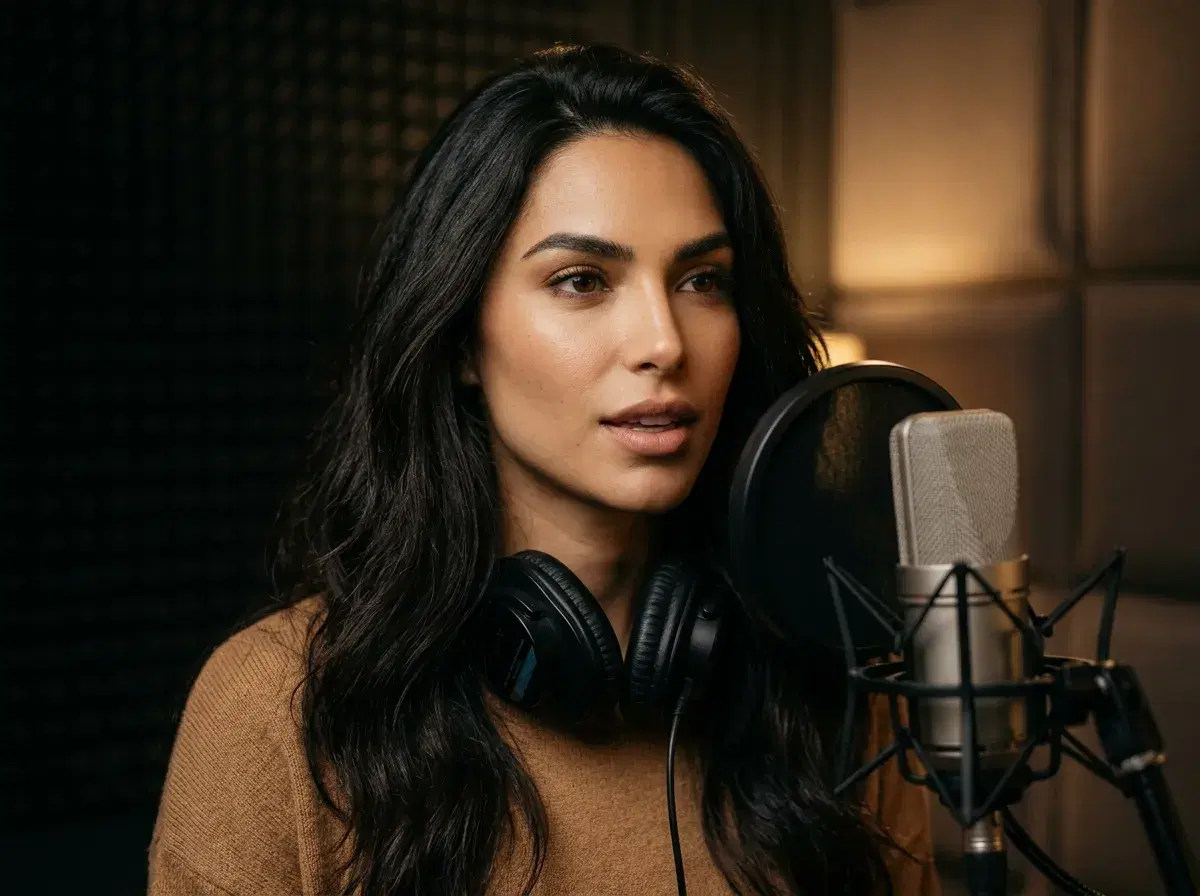
Search "AI celebrity voice cloning" and two very different things come back. One is cloning a famous person's voice without asking, which is a legal problem in most places and a platform-policy problem everywhere else. The other is what creators making celebrity-style content actually need: a cloned version of their own voice, consistent enough to carry a whole series of talking clips.
This is about the second. Pose integrates ElevenLabs natively for exactly that job, and this covers how it fits into the video workflow, how it compares to going direct, and where the consent line sits.
The voice lands inside the clip — see Pose AI video generation.
- Voice cloning here means cloning your own voice so a persona sounds the same across every talking clip — not impersonating a real public figure.
- Pose integrates ElevenLabs natively, so audio and lip-sync are generated together inside the video rather than exported and synced by hand.
- It covers a speaking voice for narration and delivery. Singing is not what this does.
- Consent is the whole rule: your own voice is fine, someone else's needs explicit permission, a celebrity's is off the table.
- Included in the same plan — 400 credits every week, $4.99 the first week, then $14.99/week, no watermarks.
- Pose is an all-in-one celebrity-style AI platform: voice cloning via native ElevenLabs, video via native Kling and HeyGen, and photos via native Nano Banana 2 — all on one 400-credit weekly plan, not three separate subscriptions.
What voice cloning actually is
Voice cloning builds a synthetic model of a specific speaking voice from a sample of that person talking, then generates new speech in it from text you write. It is not a filter applied to a recording — nothing is being altered. The output is new audio that carries the timbre, pacing, and character of the source voice.
For creator work that matters because a persona has to sound like itself. A voiceover recorded on a good day and one recorded with a cold do not match; a cloned voice does, every time, which is the same consistency problem an identity-locked face solves on the visual side.
Why celebrity-style content needs it
Celebrity-style content is not one image — it is a run of them. A red-carpet still, a behind-the-scenes clip, a piece to camera, and an ad cut all have to feel like the same person. The face is handled by identity-locked generation; the voice is the other half, and a mismatched voice undoes a matched face immediately.
There is a practical benefit too. Rewriting a hook becomes a regeneration rather than a re-record, so testing five versions of a script costs a few minutes instead of another session in front of a microphone.
How it works inside Pose
Clone once, then write. Pose runs ElevenLabs as a native engine, and when you generate a talking clip with HeyGen the speech and the lip-sync are produced in the same pass — there is no export, no import, and no manual alignment in an editor.
That is the actual thing you are buying, and it is worth being precise about it: the audio is not better than what ElevenLabs gives you directly, because it is ElevenLabs. What is different is that it arrives already inside the video. If a voiceover file is your only deliverable, going direct is cheaper and gives you more control.
Pose vs standalone voice tools
| Tool | What it is | Where the voice lands |
|---|---|---|
| Pose (ElevenLabs native) | A video studio with cloning built into generation | Inside the finished clip, lip-synced |
| ElevenLabs direct | The benchmark voice model, used on its own | An audio file you then sync yourself |
| Resemble AI | Voice infrastructure, API-first | An API response for your own product |
| Speechify | A text-to-speech and reading product | Playback and audio export — not a video pipeline |
ElevenLabs sets the quality bar and Pose does not claim otherwise — it runs ElevenLabs. Resemble is the right pick if you are embedding voice in software, and Speechify is doing a different job entirely: it is built for listening to text, not for producing creator video. Pose's narrow claim is the last column.
For the ad-side workflow, see AI UGC videos with voice.
For a wider tool round-up, see the best AI voice cloning apps in 2026.