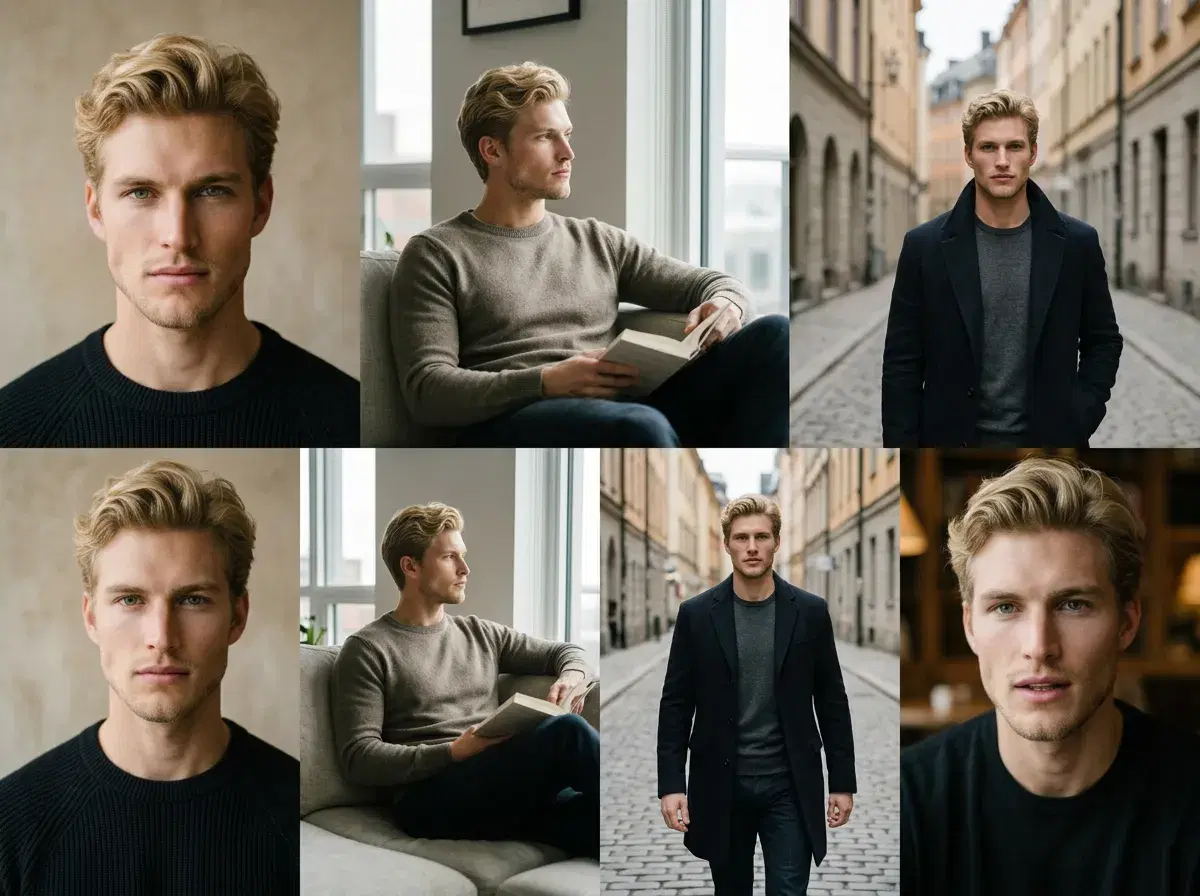
What are celeb AI pics? At the broadest level, they're AI-generated images that replicate a celebrity's aesthetic or likeness. AI celebrities are the systematic version of that: synthetic public figures — virtual influencers with their own names, faces, and followings, alongside AI personas that brands and creators run as recurring characters. What makes them possible in 2026 is not one model but a stack: an image model that holds a face steady, a video model that puts it in motion, and a voice that stays the same from clip to clip.
This guide explains what an AI celebrity actually is, walks through the four layers of that stack, and is honest about which parts a generation studio like Pose covers and which parts remain your job.
Pose generates the moving half of this natively — see AI video generation with Kling, SeedDance, Veo, Sora 2, and HeyGen.
- Celeb AI pics are AI-generated images that mimic a celebrity's style or likeness — the ethical version applies that aesthetic to your own face, not a real person's.
- Four types get searched under "AI celebrities": style cloning (celebrity-style photos of your own face), deepfakes (reconstructing a real person's likeness — not something Pose does), AI headshots (professional portraits, a related but distinct category), and virtual influencer personas (fully synthetic characters like Lil Miquela).
- Pose's approach is identity-locked style cloning: Nano Banana 2 reads your face from one selfie, no training step, and applies celebrity-style lighting and staging.
- The stack has four layers: a persona you define, identity-locked images (Nano Banana 2), native video (Kling, SeedDance, Wan, Veo, Sora 2, HeyGen), and a cloned voice (ElevenLabs).
- Pose covers the generation layers in one studio on 400 credits every week, from $4.99 the first week, then $14.99/week with no watermarks.
What is an AI celebrity?
An AI celebrity is a synthetic persona that occupies the role a human public figure would: it has a recognizable face, a name, a body of content, and an audience that follows it. Lil Miquela is the canonical example — a computer-generated character with millions of followers and brand partnerships, run as an ongoing account rather than a one-off image.
The term also covers a softer case: creators and brands who run an identity-locked version of a real person — often themselves — as a persona at a volume no photoshoot schedule could sustain. Both cases depend on the same thing, which is that the character looks like itself in every single piece of content. A persona whose face drifts between posts is not a persona; it is a series of unrelated pictures.
Layer one: the persona
Before any generation happens, you decide who this character is: what they look like, what they wear, where they are usually photographed, and what they talk about. This part is not a model output — it is a creative brief, and it is the layer most people skip.
It matters because everything downstream is a consistency problem. If the brief says warm daylight, muted knitwear, and city apartments, then the image prompts, the video scenes, and the voice all have something to be consistent with. Without it, each generation drifts toward whatever the model finds most probable, and the persona never settles.
Layer two: identity-locked images
This is where the face gets fixed. Pose generates images with Nano Banana 2 from a single selfie, identity-locked, with no training step — the same face carries across every style you generate, whether that is an editorial portrait, a street scene, or a studio shot. Flux Kontext and GPT-image 2 are also available natively for different looks.
The practical effect is that a feed hangs together. Twenty images generated across a week read as twenty photographs of one person rather than twenty attempts at a similar person, which is the single difference between a persona and a moodboard.
For the portrait end of the stack, see the Pose AI headshot studio.
Layer three: native video
Photos alone will not sustain a persona in 2026 — the formats that carry reach are vertical clips. Pose runs six video engines natively, and they do different jobs: Kling for controlled camera movement, SeedDance for body motion and motion transfer, Wan for fast iteration, Veo and Sora 2 for photorealistic scenes and longer takes, and HeyGen for talking-head delivery.
Because the identity lock carries from the image model into the video models, a clip generated on Tuesday still reads as the same character as a photo posted on Monday. Nothing gets exported to a separate tool, and everything draws from the same weekly credit pool.
Layer four: the voice
A persona that speaks needs to sound the same every time. Pose integrates ElevenLabs natively for voice cloning, so a talking-head clip is generated with the audio and the lip-sync produced together rather than recorded separately and synced afterward.
Two honest limits. Cloning is for a speaking voice — narration and delivery, not singing. And you need the right to the voice you clone: your own is fine, someone else's needs their explicit permission, and a real public figure's voice is a legal problem regardless of how good the output sounds.
The AI celebrity stack, layer by layer
| Layer | What it produces | In Pose |
|---|---|---|
| Persona | The brief: face, wardrobe, setting, subject matter | Yours — no model writes this for you |
| Images | Identity-consistent stills across styles | Nano Banana 2, Flux Kontext, GPT-image 2 |
| Video | Vertical clips, motion, talking heads | Kling, SeedDance, Wan, Veo, Sora 2, HeyGen |
| Voice | A consistent speaking voice, lip-synced | ElevenLabs, native |
| Distribution | Posting, scheduling, disclosure, community | Not in Pose — you run the account |
Pose covers the three generation layers in one studio on one plan, which is the part that usually costs the most in tool sprawl. The first and last rows are worth reading carefully: the persona brief and the account itself are still human work, and no generator substitutes for either.
One plan covers every layer above — see Pose AI pricing for the weekly credit allowance.