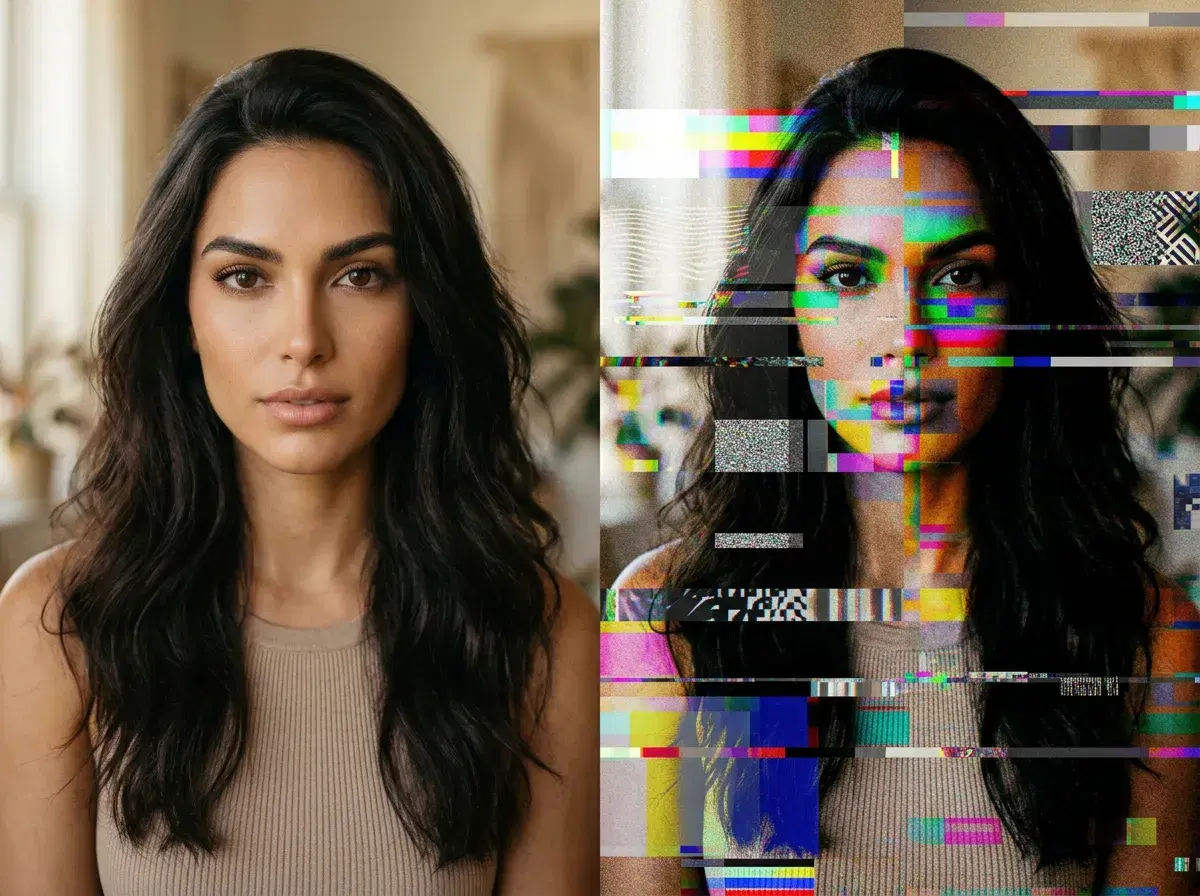
"AI influencer photos" and "deepfakes" get used interchangeably, but they describe different risk categories. This is about the distinction creators actually need — consent, whose identity is being used, and where the legal exposure sits.
- A deepfake reconstructs a specific real person's face or voice, usually without consent — that's where publicity-rights and synthetic-media-law exposure concentrates.
- An AI influencer photo, in Pose's model, is generated from your own consented, uploaded selfie — the identity being used is yours.
- Pose's consent model: you upload your own photo, generate content of yourself, and no other real person's likeness is reconstructed without their own consented upload.
Key terms
Deepfake: AI-generated media that reconstructs a specific real person's face, voice, or likeness in a scene or statement they didn't actually make.
Consent-based cloning: generating content from a person's own uploaded photo, with their own consent, of their own likeness.
Synthetic media: the broad category covering both — any media generated or substantially altered by AI, regardless of whose identity is involved or whether consent was given.
AI-generated vs. deepfake vs. real photo
| AI-generated (identity-locked, own face) | Deepfake | Real photo | |
|---|---|---|---|
| Whose identity | Yours — your own uploaded selfie | A specific real person, usually not the creator | Whoever the camera captured |
| Consent | You consent to your own generation | Typically none from the person depicted | N/A — a captured moment, not generated |
| Typical intent | Content creation, style exploration | Impersonation, deception, or non-consensual use | Documentation of an actual moment |
| Legal exposure | Low, for content of your own consented likeness | High — publicity rights and synthetic-media laws increasingly apply | N/A |
Spotting the difference from the outside
If you're a follower rather than the creator, the consent distinction above isn't visible from the image alone — an AI influencer photo and a deepfake can look identical on screen. What can help are the same visual signals used to catch any AI-generated image: hand and finger artifacts, warped background text, inconsistent jewelry, and lighting that doesn't quite agree with the rest of the frame. None of these proves consent status either way; they only suggest whether an image is AI-generated at all, which is a separate question from whether it's a deepfake of someone real.
For the full checklist, see how to spot fake celebrity AI images.
See native video generation for turning influencer photos into clips.
See AI headshots for the same identity-lock mechanism.