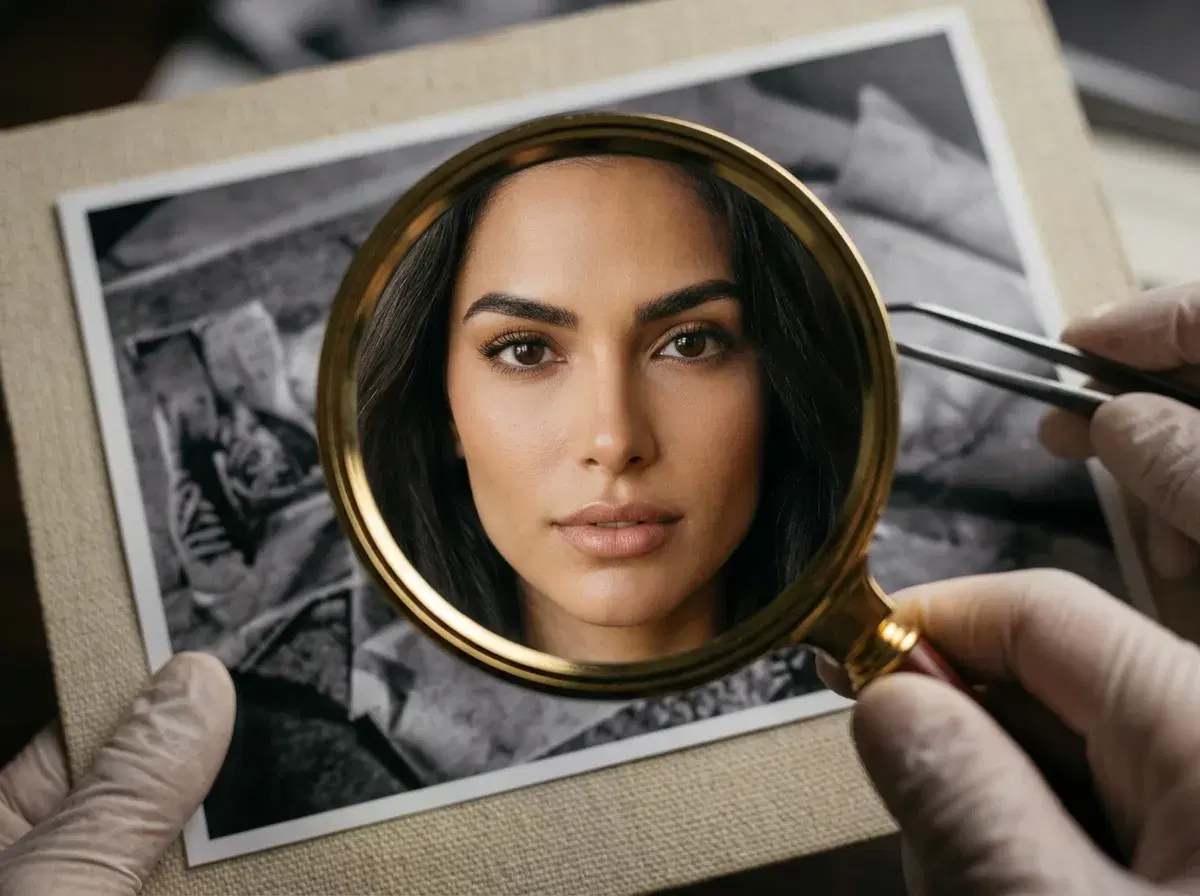
Fake celebrity AI images circulate constantly, and they're often photorealistic enough to pass at a glance. There's no single foolproof test, but a handful of practical checks — used together — catch a meaningful share of them.
- Inconsistent hands and fingers — extra, missing, or fused digits, or an unnatural bend.
- Mismatched lighting or shadows — light that doesn't agree across the frame, or a shadow falling the wrong way.
- Unnatural skin texture or background artifacts — overly smooth skin, warped background text, or repeated patterns.
- Odd text or logos in the background — AI models frequently render illegible or garbled text and logos.
- Inconsistency across multiple photos of the 'same' event — details (outfit, jewelry, setting) that shift between images claiming to show the same moment.
Visual artifacts: hands, teeth, asymmetry, background
This is the most accessible check. Look closely at hands — AI generation still struggles with the exact number and positioning of fingers more often than with faces. Check teeth for unnatural evenness or misalignment, and look for facial asymmetry that reads as slightly off rather than characterful.
Backgrounds are a common tell: warped or illegible text on signs, garments, or logos, and repeating patterns that don't quite make sense (a crowd where faces blur into each other unnaturally, or fabric patterns that don't continue logically) are frequent signals in lower-quality generations.
None of these are proof on their own — higher-quality models increasingly avoid them — but a cluster of two or three of these signals in one image is worth treating with real skepticism.
Metadata checks
Image files can carry EXIF metadata — camera model, software used, timestamps. In principle this could reveal AI-generation software. In practice, this is a weak signal: metadata is routinely stripped when an image is saved, compressed, or uploaded to social media, and it can be edited or spoofed outright. Absence of expected camera metadata doesn't prove an image is AI-generated, and its presence doesn't prove it's real.
Reverse image search
Running the image through a reverse image search can surface an earlier version of the same photo in a different context, or show it already flagged as synthetic elsewhere. This is one of the more reliable practical checks available to a non-expert, especially for images that have been circulating for a while.
AI detection tools
A number of tools claim to score images for AI-generation likelihood. Be honest with yourself about what these tools actually are: an evolving, imperfect field, not an authoritative verdict. Accuracy varies by tool, by how the image was generated, and by how it was compressed or re-processed after generation. Treat any single detector's output as one data point, not a final answer.
For a deeper look at whether viral celebrity images are real, see Are Celebrity AI Images Real in 2026?.