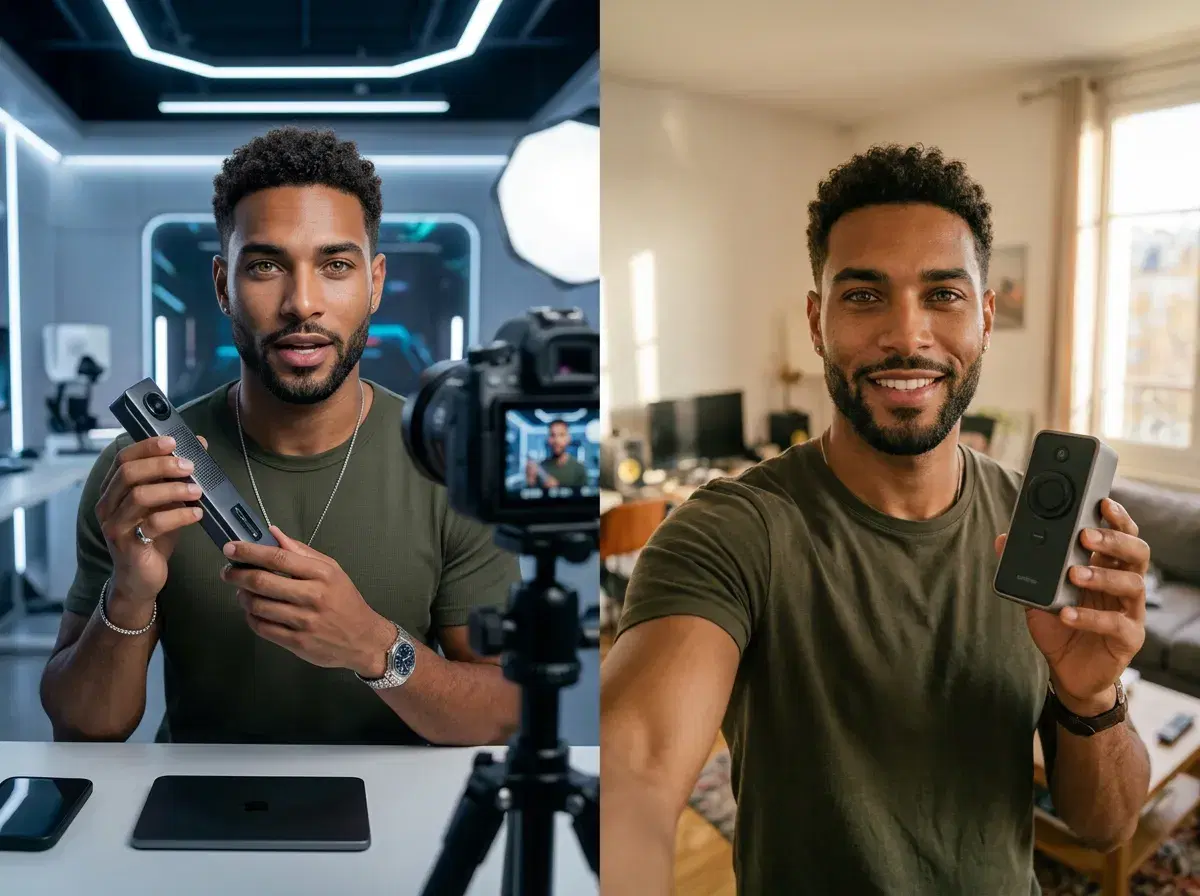
AI UGC vs real UGC is one of the most practical questions facing performance marketers in 2026. Both formats appear in paid social feeds. Both can drive conversions. And yet they work differently, cost differently, and succeed in different contexts. Understanding those differences is what separates brands that burn budget guessing from ones that know exactly which format to deploy — and when.
For the purposes of this comparison, AI UGC means video content created using AI tools — in Pose AI's case, talking video templates voiced by AI influencers from The Cast, generated in minutes from a script. Real UGC means content filmed by actual customers, micro-influencers, or hired creators: a person on camera speaking authentically about a product, filmed on a phone or simple camera setup.
The comparison framework here covers six factors that matter to performance marketers: cost, speed, trust, scalability, platform performance, and brand safety. Each factor has a different winner depending on your campaign goals. The sections below walk through all eight comparison criteria in detail, explain exactly when each format has the edge, and close with a hybrid workflow for brands that want to use both strategically.
- AI UGC vs real UGC for ads comes down to trade-offs: AI UGC wins on speed and cost for testing, while real UGC wins on trust and emotional storytelling — most brands test with AI and scale the winners with real creators.
- Speed: AI UGC generates dozens of ad variations in minutes; real UGC takes days to weeks of briefing, filming, and edits.
- Cost: AI UGC runs a fraction of a hired shoot — roughly $0.50 per video vs $100–500 per real creator video.
- Trust: real faces still read as more authentic, so real UGC has the edge on high-consideration purchases.
- Performance: CTR, CPA, and conversion vary widely by hook and audience — test both against your own funnel rather than assuming one always wins.
AI UGC vs real UGC: side-by-side comparison
| Factor | AI UGC (Pose AI) | Real UGC (Hired Creators) | Winner |
|---|---|---|---|
| Cost per video | $0.50 (10 credits) | $100–500 per creator video | AI UGC |
| Production speed | Minutes from script to final | Days to weeks (briefing, filming, editing) | AI UGC |
| Perceived authenticity | Lower — AI faces are recognized by some viewers | Higher — real humans build instinctive trust | Real UGC |
| Volume scalability | Hundreds of variations from one session | Limited by creator availability and budget | AI UGC |
| Platform compliance | Acceptable on Meta and TikTok with AI disclosure | No disclosure needed | Real UGC (marginally) |
| Brand safety | Full control — no creator variability | Requires vetting and contracts | AI UGC |
| Emotional resonance | Moderate — template delivery can feel scripted | High — personal stories and real reactions convert | Real UGC |
| Testing velocity | Run 15 hook variations for $7.50 | $750+ to test the same hooks with real creators | AI UGC |
Neither format dominates across every factor. AI UGC is the clear winner for cost and speed; real UGC is the clear winner for emotional depth and initial trust-building.
AI UGC vs real UGC: performance metrics
| Metric | AI UGC (Pose AI) | Real UGC (Hired Creators) |
|---|---|---|
| CTR (click-through rate) | Varies by hook; high testing volume helps you find winning hooks fast | Varies by hook; strong when authentic storytelling matches the audience |
| CPA (cost per acquisition) | Lower testing cost lowers cost-per-test, which can pull blended CPA down | Higher production cost per creative, but proven winners can convert efficiently |
| Trust / authenticity | Improving, but real faces still read as more authentic to many viewers | Higher perceived authenticity, especially for high-consideration purchases |
| Production time | Minutes per variation, no filming or scheduling | Days to weeks (briefing, filming, edits, revisions) |
| Cost per creative | A fraction of a hired shoot (roughly $0.50 per video in Pose) | $100–500+ per creator video, plus usage rights |
AI UGC leads on production time and cost per creative; real UGC leads on trust. CTR and CPA are not inherent to either format — they depend on the creative and the offer, so the reliable approach is to A/B test both against your own funnel.
When to use AI UGC
Use AI UGC when you need to test 10 or more hook variations in under an hour. Testing is where AI-generated content pays for itself most visibly. Writing a new hook, rendering it with an AI influencer, and exporting it for a Meta or TikTok ad takes minutes. Running the same test with real creators takes a week of back-and-forth and costs hundreds of dollars before you know whether the concept works. If your goal is to find the hooks that resonate before committing real production budget, AI UGC is the rational first step.
Product demos and feature showcases are another strong use case. When the goal is showing how something works rather than building an emotional connection to it, AI talking-head videos deliver the information cleanly. A DTC brand launching a new skincare routine, a SaaS company explaining a new feature, or an e-commerce retailer walking through sizing guidance can all use AI UGC to cover the informational layer of their funnel without hiring a creator for every update.
Geographic and demographic variations are expensive to produce with real creators and trivial to produce with AI. If you run ads across multiple countries or want to test different audience segments, AI UGC lets you generate the same script with different AI influencers from The Cast — varying tone, presentation style, and visual identity — at effectively zero marginal cost per variation. A single ad campaign can test six casting variations for less than $3 in credits.
Budget-constrained campaigns are an obvious fit. A brand spending $500 on test ad creative cannot afford four real creator videos. It can afford hundreds of AI UGC variations. For early-stage brands validating a product-market fit before scaling, AI UGC compresses the testing phase from months to days.
Seasonal and time-sensitive content benefits from AI UGC's production speed. A Valentine's Day campaign that needs 20 variations of the same promotion — different hooks, different emotional angles, different product highlights — can be generated and scheduled in an afternoon. Real creator content for the same brief would require a two-week runway to brief, film, and edit.
When to use real UGC
Use real UGC for brand launches and first impressions. When potential customers encounter your brand for the first time, the instinctive human response to a real face — one that appears genuine, emotionally present, and accountable — is more powerful than any AI can currently replicate. First-touch ads benefit from the trust signal that comes from a real person saying they have used your product and it worked. AI UGC can support brand awareness once that initial trust is established, but it rarely builds it.
High-consideration purchases require real UGC. When someone is deciding whether to buy a car, a piece of health technology, a financial product, or a medical device, the stakes of getting it wrong are high enough that they are actively reading for social proof. A real customer describing a specific result — in their own words, in a genuine setting — carries weight that a scripted AI delivery cannot match. The informational gap between the two formats is too wide for AI UGC to close in these categories.
Community-building campaigns work better with real customer stories. If your brand's value proposition is built around belonging to a group — a fitness community, a parenting community, a professional network — real UGC reinforces that the community is made of real people. AI influencers can extend reach but they cannot be members of a community in the way a genuine customer can. User-submitted video reviews, transformation stories, and before-and-after testimonials generate social proof that is category-specific and hard to fake.
Platforms with strict AI-content policies are worth monitoring. As of early 2026, Meta and TikTok both accept AI-generated content with appropriate labeling. That may change. A real UGC library built from genuine creators gives you ad creative that remains compliant regardless of how platform policies evolve. For brands in highly regulated industries where authenticity claims matter legally, real UGC also provides a cleaner paper trail.
The smart marketer's playbook: test AI, scale real
- 1Generate 10–15 AI UGC variations in PoseWrite 3–5 hook variations for your core message. Use different AI influencers from The Cast for each hook — Alicia for a warm, conversational tone; Chloe or Sofia for a more direct, energetic delivery. Apply different motion templates to vary the visual pacing. Aim for at least 12 distinct videos before you spend a dollar on media. Total cost: roughly $6 in credits.
- 2Run $50–100 test campaigns on Meta or TikTokPush all 12–15 variations into a single test campaign with a small daily budget and let the platform's delivery algorithm surface the early winners. Run for 4–7 days. Focus on CTR and cost per landing page view as your primary signals at this stage — you are looking for hooks that earn the click, not necessarily final purchase conversion.
- 3Identify the top 2–3 performersAfter the test period, sort your variations by CTR and cost per click. The top 2–3 performers are your proof-of-concept hooks. Study what they have in common: is it the opening line? The specific benefit claim? The pacing? Documenting this is as important as identifying the winners — it tells you what your audience is responding to.
- 4Brief real creators to recreate the winning conceptsTake the winning AI UGC scripts verbatim — or close to it — and brief 2–4 real micro-influencers or customers to film their own version. Give them the hook and the key message; let the delivery and personal detail be their own. You are not asking them to impersonate an AI influencer. You are using the validated concept as a creative brief that you know works.
- 5Scale the real UGC winners and continue testing with AIOnce real UGC versions of your proven hooks are live, scale the budget behind the performers. Continue running AI UGC in a separate test campaign to explore new concepts and seasonal hooks. The two formats run in parallel: real UGC carries your proven campaigns at scale, AI UGC keeps your testing pipeline full. This combination is cheaper, faster, and more data-driven than starting every creative cycle with a real creator brief.
A concrete example of the hybrid workflow
A DTC skincare brand tested 12 Direct Hook UGC videos in Pose using three AI influencers from The Cast. Each video led with a different version of the same core promise: clearer skin in seven days. Three variations — all emphasizing 'glass skin in 7 days' as the opening line, with a product close-up in the first two seconds — achieved a 4.2% CTR on TikTok. The remaining nine variations averaged 1.1% CTR. Total cost for all 12 videos: $6 in Pose credits.
The brand then briefed three real micro-influencers to film the same hook in their own style, using the 'glass skin in 7 days' framing as their starting point. Each creator filmed one video in their own setting, with their own phrasing after the hook. The three real UGC videos converted 18% better than the AI UGC versions at the same media spend — but the AI test cost $6 and the real creator shoots cost $900 including briefing, review, and editing time.
The net outcome: the brand spent $906 to find a winning concept and scale it, rather than spending $900 upfront on real creators before knowing which angle worked. The AI testing phase de-risked the creative investment entirely. This is the economics that make the hybrid workflow rational for any brand running performance campaigns.
ROI comparison: 50 video variations
AI disclosure requirements in 2026
Both Meta and TikTok require advertisers to disclose AI-generated content in ad creative as of 2026. On Meta, this means using the platform's built-in AI label when uploading creative. On TikTok, the Advertising Policies require disclosure for AI-generated images and video. The disclosure typically appears as a small label on the ad unit — it does not prevent the ad from running or substantially reduce delivery.
Early data on disclosed AI ads suggests that the disclosure itself has a minimal effect on CTR for most product categories. Audiences in beauty, apparel, food, and consumer tech appear to engage with AI UGC at roughly similar rates to real creator content when the hook and creative concept are strong. High-consideration categories — financial products, healthcare, insurance — show a more pronounced preference for real human content even after controlling for hook quality.
The practical recommendation is to disclose accurately, monitor platform policy updates quarterly, and maintain a real UGC library as a contingency. Platform policies are an evolving area; brands that have invested in real creator relationships are better positioned to adapt if AI content rules become more restrictive.
From a brand safety standpoint, AI UGC has an advantage: you control the script completely. There is no off-brief creator, no controversial statement made in an adjacent piece of content, and no talent availability issue mid-campaign. For brands that have been burned by creator-related brand safety incidents, AI UGC eliminates a category of operational risk entirely.
Platform performance data
Performance benchmarks for AI UGC vs real UGC vary significantly by platform, vertical, and creative quality. The patterns that have emerged across campaigns using both formats point to a few consistent findings.
On TikTok, real UGC from creators with existing followings — even micro-influencers with 5,000–50,000 followers — outperforms AI UGC in brand recall and comment engagement. The social proof element of a recognizable creator matters on a platform where social currency is part of the content experience. AI UGC performs more comparably on TikTok Ads Manager placements where the creator's following does not transfer.
On Meta — Instagram Reels placements in particular — the gap between AI and real UGC is narrower. Users scroll past both formats at similar rates when the hook is strong. AI UGC with a sharp, specific opening line tends to hold view duration as well as real creator content for the first 3–5 seconds. After that point, real creator content with a personal story arc tends to retain viewers longer.
YouTube pre-roll is not a strong use case for either short-form UGC format. Connected TV placements, where longer form and higher production values are expected, also fall outside the AI UGC use case as currently implemented. Both formats perform best in feed placements on mobile platforms where the viewing context is fast-scroll and the attention window is short.
Frequently asked questions
Can AI UGC perform as well as real UGC in paid ads?
Do I need to disclose AI-generated content in my ads?
What is the biggest advantage of AI UGC?
What is the biggest advantage of real UGC?
Can I use Pose AI influencers on Instagram?
How much does it cost to produce 50 AI UGC videos with Pose?
Are AI UGC ads labeled differently in the feed from real creator ads?
What types of products work best with AI UGC ads?
When does AI UGC outperform real UGC?
Does AI UGC work for high-ticket products?
The bottom line
AI UGC and real UGC are not competing formats — they are sequential ones. AI UGC is the right tool for the testing and exploration phase of any performance campaign. It is fast, cheap, and allows you to make creative decisions based on data rather than gut instinct. Real UGC is the right tool for scaling the concepts that testing has proven to work, and for categories where emotional authenticity is load-bearing.
The brands that get the most out of both formats are the ones that stop treating creative production as a fixed cost and start treating it as a variable with a return. Testing 15 hooks with AI UGC for $7.50 before spending $1,500 on real creator videos is not a compromise on quality — it is how quality is actually achieved in a world where attention is expensive and feedback is fast.
For marketers looking to start with AI UGC, the path is straightforward: generate a batch of hook variations using Pose AI's UGC templates and The Cast, run a small test campaign, and let the data tell you which concept deserves a real creator's face on it.