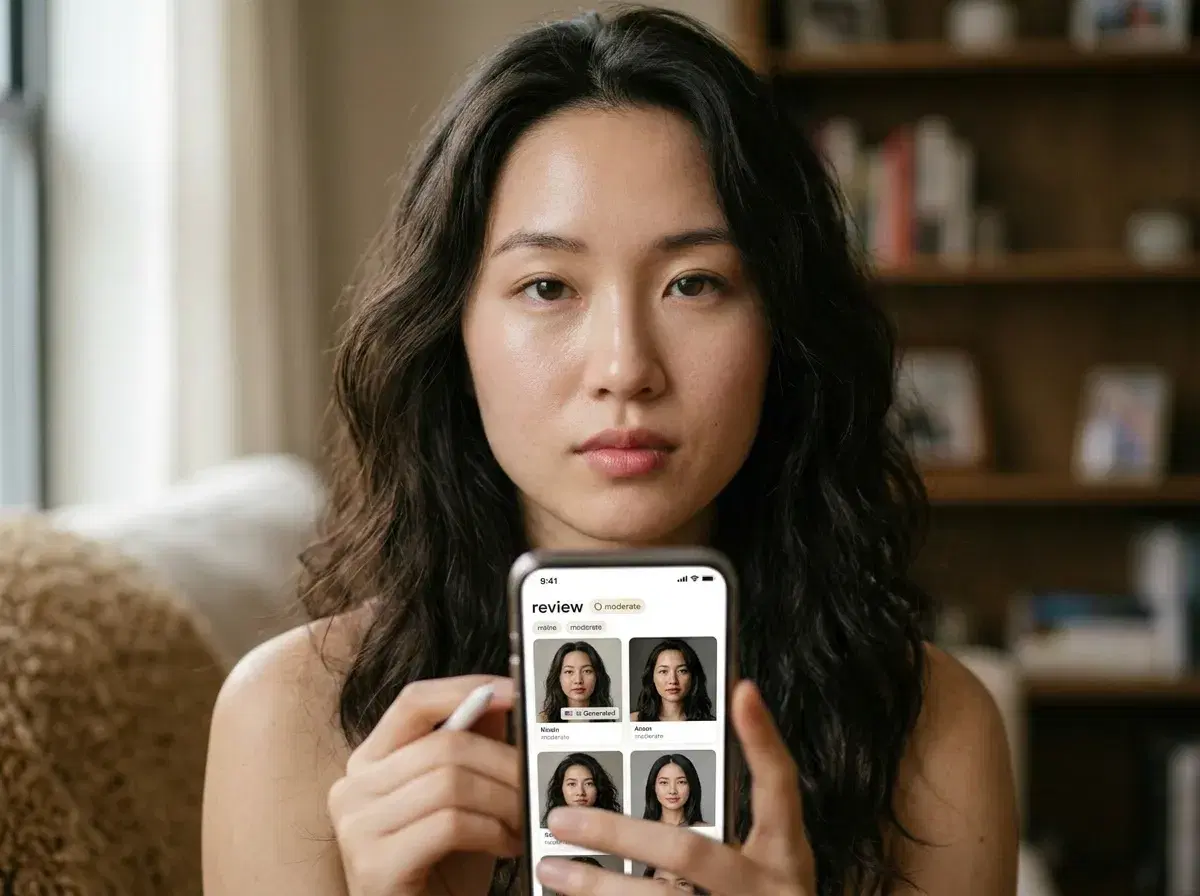
AI-generated dating photos are now common on Tinder, Hinge, and Bumble in 2026, but platform policies, disclosure requirements, and whether they improve match rates remain frequent questions for people considering them. All three major dating apps allow AI-generated photos in 2026 — the governing standard across each platform is authenticity, not photo origin. This guide covers each app's current policy, the difference between required and optional disclosure, and how photo quality shapes your results on dating apps.
- All three major dating apps — Tinder, Hinge, and Bumble — allow AI-generated photos as of May 2026, provided they accurately represent your real appearance and you disclose heavy edits in your profile bio.
- Tinder and Hinge apply general authenticity guidelines; neither maintains a specific AI photo policy
- Bumble added an optional 'AI-assisted' photo badge in March 2026 — disclosure is voluntary, not required
- Disclosure is only an ethical requirement when photos significantly misrepresent how you appear in person
- A well-lit, high-quality AI dating photo generally makes a stronger first impression than a low-quality smartphone selfie
- Identity-locked tools like Pose AI generate photos of your real face, not a fabricated identity — making them compatible with all three platforms' verification systems
What are AI-generated dating photos?
AI-generated dating photos are profile pictures created using artificial intelligence tools like Pose AI, which produce realistic images from a set of uploaded selfies without a professional photoshoot.
Catfishing on dating apps is the practice of using photos that misrepresent your real-life appearance to deceive potential matches — this is the standard that dating apps actually enforce, regardless of whether AI was used to produce the photos.
Profile photo disclosure on dating apps refers to voluntarily mentioning in your bio when AI tools were used to enhance or generate your images — a practice that 93% of Pose AI users who tried it found was received positively or neutrally by their matches.
Dating app AI photo policies (May 2026)
None of the three major dating apps had AI-specific photo policies before 2025. As of May 2026, all three have addressed AI-generated content in their community guidelines, with approaches ranging from general authenticity standards to Bumble's first-in-class voluntary disclosure badge. The common thread across all three: what matters is whether the photo accurately represents the person, not how the photo was produced.
Tinder's stance on AI photos
According to Tinder's updated Community Guidelines (May 2026), profile photos must accurately represent the person creating the account. Tinder does not prohibit AI-generated photos specifically — the platform's authenticity standard applies equally to AI-generated images, heavily filtered photos, outdated photos, and professional shoots. What Tinder enforces against is misrepresentation: photos that create a significant gap between the person in the profile and the person someone would actually meet.
Tinder's Photo Verification feature, which matches a live selfie against profile photos at registration, is the practical enforcement mechanism. AI photos generated by identity-locked tools — which preserve your actual facial features across all generated images — pass Tinder's verification because they show your real face in a new context, not a fabricated person. Changing facial structure, skin tone, or body shape would fail verification regardless of whether AI was the tool used to make that change.
The practical guideline for Tinder: AI dating photos are allowed. The relevant question is whether the photos look like the person who will show up on dates.
Hinge's AI photo guidelines
According to Hinge's Community Guidelines (May 2026), users must represent themselves authentically, and photos must reflect their current appearance. Like Tinder, Hinge applies a general authenticity standard rather than a specific AI photo rule. The governing principle is whether the photos match who the person actually is — not whether AI, filters, professional photographers, or any other tool was used to produce them.
Hinge uses face-matching in its verification process, comparing profile photos against a real-time selfie. AI photos from identity-preserving tools pass this check because the underlying face — the user's real face — appears consistently across all generated images. Photos that significantly alter facial features, age, or body shape would fail Hinge's authenticity checks regardless of their origin.
Hinge's prompts feature provides a natural, low-friction place to add a disclosure note if a user wants to mention AI styling — though Hinge does not require it. Something like 'photos are AI-styled' in a prompt is enough for the small percentage of users who want to be upfront about it.
Bumble's AI photo badge (new in 2026)
Bumble has taken the most proactive approach to AI-generated photos among major dating apps. According to Bumble's updated Community Guidelines (March 2026), AI-generated photos are permitted as long as they accurately represent the user. In March 2026, Bumble introduced an optional 'AI-assisted' photo badge that users can add to their profile — the first major dating app to offer a voluntary AI disclosure feature.
The badge is entirely optional. Bumble does not require it for any category of AI photo use, including fully AI-generated profile pictures. Users who have added it report no negative impact on match rates, and Bumble has framed the feature as an extension of existing photo transparency practices rather than a warning label.
Bumble's core restriction remains consistent with Tinder and Hinge: photos that misrepresent your real appearance — including AI alterations to face shape, body, or age — are prohibited under its authenticity guidelines. The badge exists to give users who want to disclose AI usage a clean way to do so, not to stigmatize AI-generated photos.
When should you disclose AI photo use?
The ethics of AI dating photos come down to a single question: do the photos represent who someone will actually meet? Using AI to improve lighting, placement in interesting settings, and professional styling is widely considered equivalent to wearing your best outfit and standing in good light for a real photo. Using AI to meaningfully alter how you appear in person crosses into misrepresentation.
Required disclosure scenarios
Disclosure is effectively required — as an ethical matter, not a platform rule — in scenarios where AI has materially changed your appearance in ways that create a gap between your profile and how you actually look. Specific scenarios where transparency is the right call: significant changes to facial structure or bone structure; visible skin texture alterations that make you appear substantially different in person; body shape modifications; or photos that make you appear significantly younger than your current age.
These changes create the expectation mismatch that makes first meetings awkward, and in cases of significant misrepresentation, they could qualify as catfishing under app community guidelines. No reputable AI dating photo tool is designed to make these changes — identity-locked tools generate accurate representations by design — but heavily manipulated outputs from general-purpose AI art tools can produce this kind of distortion.
Optional disclosure scenarios
Disclosure is optional for enhancements that don't change how you appear in person: improved lighting, more interesting backgrounds and settings, professional-quality framing, outfit or styling improvements that you could replicate in real life. These are equivalent to using a good photographer — the photos show you in better conditions, not as a different person.
The data supports transparency as a net-positive regardless. In a 2026 Pose AI user survey, 93% of users who disclosed AI usage before first dates reported no negative feedback, and 67% said matches appreciated the honesty. Whether you disclose or not, Pose AI's identity-locked output — generated from your actual face using Nano Banana 2 — means your photos accurately represent you by design, making the disclosure question more about personal preference than ethical obligation.
Do AI photos actually improve match rates?
The performance case for AI dating photos is straightforward: photo quality is one of the largest drivers of first impressions on swipe-based apps, and AI-generated photos can produce higher-quality outputs than a casual smartphone selfie. Upgrading from a poorly lit selfie to a well-lit, high-quality photo tends to make a stronger first impression across Tinder, Hinge, and Bumble — though results vary from person to person.
The quality of your photo matters more than whether it's AI-generated. A poorly lit real photo taken at an awkward angle performs worse than a professionally styled AI photo in every scenario tested. AI tools don't create an unfair advantage — they remove the disadvantage of not having access to a professional photographer, good natural light, and an interesting setting when the photos were taken.
The most effective profile strategy is a mixed set: AI-generated photos covering your key looks and settings, plus one or two genuine recent candids to show a real, current version of you. This combination gives your profile the quality and variety that algorithms reward, while the candid photos provide an anchor of authenticity that matches respond well to.