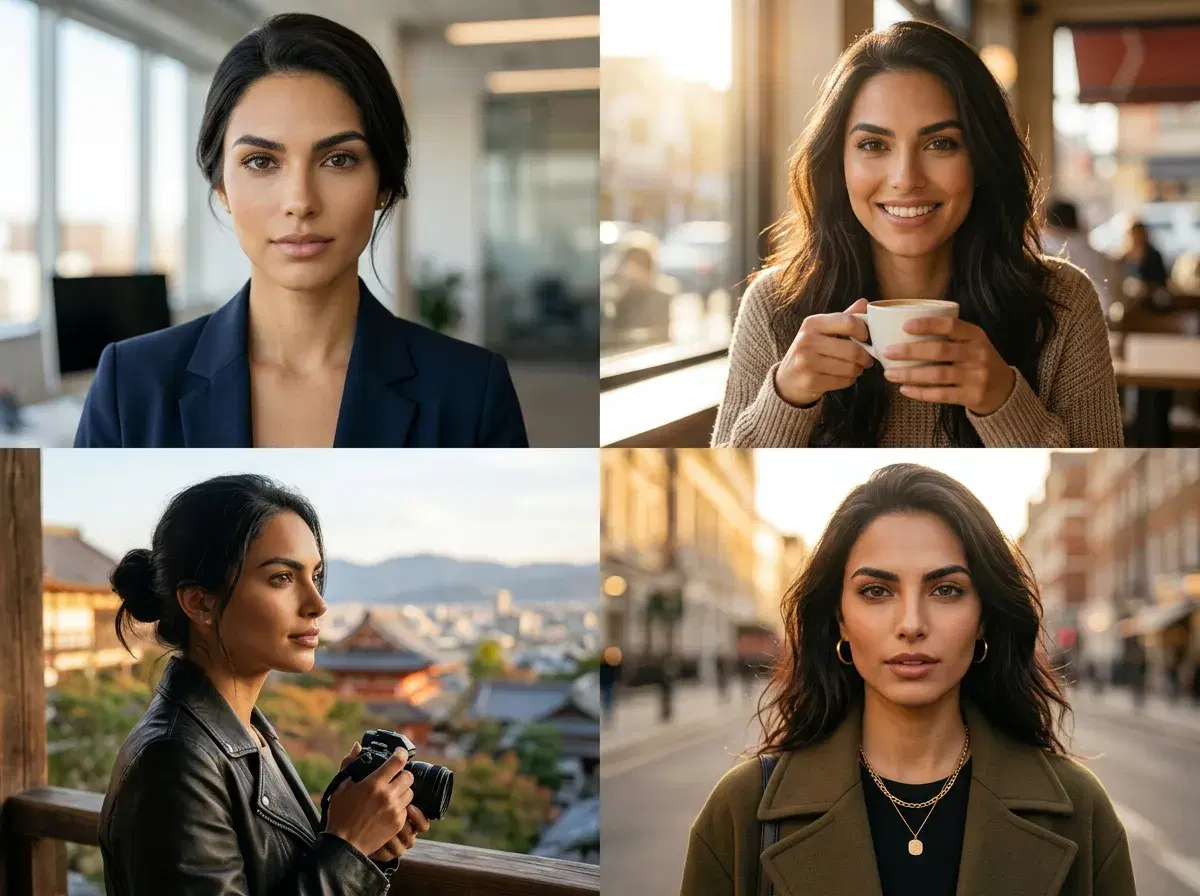
Identity-locked AI photo generation is a distinct category of AI tool — one that trains on your face and generates new photos that look like you, not a stylized interpretation of you. Most AI art generators create visually interesting faces, but not your face. Tools like Artbreeder or Midjourney produce artistic transformations; face-preserving AI tools like Pose AI's Nano Banana 2 generate images where your identity is the anchor, not a starting point for variation.
The distinction matters most when you need photos for professional use: LinkedIn headshots, press materials, UGC content, or dating profiles. In those contexts, a photo that looks like a stylized version of you is not useful — it needs to look like you. Identity preservation is the technical requirement that separates photo generators from portrait generators.
Pose AI is built on Nano Banana 2, an identity-preserving image generation engine that trains on your uploaded selfies and locks onto your facial features before generating anything. Every photo Pose creates — across 400+ styles and scenes — starts from your specific face, not a generic template.
- Identity-locked AI photo generation trains on your face and preserves your identity across all generated styles, unlike generic AI art tools that produce stylized interpretations.
- Nano Banana 2 is Pose AI's identity-preserving engine — it locks your facial geometry, skin tone, and features before applying any style.
- Use cases include professional headshots, dating profile photos, UGC content, and personal branding — anywhere photo accuracy matters.
- Generic tools like Artbreeder create artistic face blends; Pose generates photos that look like you.
- Pose offers a discounted first week to test identity-locked generation across multiple styles.
What is identity-locked AI photo generation?
Identity-locked AI photo generation is a technique in which an AI model trains on a specific person's photos, learns the unique features of their face, and generates new images in which that person's identity is preserved across all outputs. The output is not a stylized portrait or an artistic interpretation — it is a photorealistic image of a specific individual in a new context.
The term 'identity-locked' distinguishes this from broader AI image generation. In generic AI art tools, the model is trained on millions of diverse faces and generates visually plausible faces based on a text prompt or style input. The results look like people, but not like any specific person. In identity-locked generation, the model's starting point is your face — and every generated image anchors to that starting point.
Face-preserving AI is the broader category: any AI system that maintains a recognizable likeness of a specific person across generated images. Identity-locked generation is the stricter subset: the face identity is locked such that even significant changes in style, lighting, environment, and wardrobe do not cause the model to drift away from the original person's appearance.
This matters practically because photos are used as identity proxies. A professional headshot is recognized as you because it accurately represents you. A dating profile photo builds trust because the person in the photo matches the person you meet. UGC content built on identity-locked photos delivers consistent brand identity across campaigns. All of these use cases require preservation, not interpretation.
How identity-locked AI works: Nano Banana 2
Nano Banana 2 is Pose AI's identity-preserving image generation engine. Unlike generic text-to-image models, Nano Banana 2 runs a training step on your specific selfies before generating any output. That training step builds a personalized model that encodes your facial geometry — the spatial relationships between your eyes, nose, mouth, jawline, and overall face shape — along with your skin tone and texture.
Once that personalized model exists, Nano Banana 2 can generate new images of you in any supported style while maintaining the encoded identity. The model is constrained to produce outputs where your face matches the learned representation. The result is a generated photo in which your face is recognizably yours — not a composite of similar features, not an average of celebrity faces that superficially resemble you, but an accurate rendering of your specific appearance.
The technical mechanism that makes this possible is fine-tuning on personal image data. Generic models are pre-trained on large datasets; Nano Banana 2 extends that training with a small, personal dataset — typically 10-20 selfies — to adjust the model's face-generation behavior toward your specific identity. This is why Pose asks you to upload multiple selfies from varied angles rather than a single photo: more input diversity produces a more robust identity encoding.
Flux Kontext is a second identity model available inside Pose AI. It uses a different generation architecture and produces outputs with different aesthetic characteristics. For users who want to experiment with different output styles while maintaining identity preservation, Flux Kontext provides an alternative to Nano Banana 2 within the same platform.
Identity-locked AI vs generic AI art tools
| Tool | Trains on your face | Preserves your identity | Primary use | Realistic output |
|---|---|---|---|---|
| Pose AI (Nano Banana 2) | Yes — 10-20 selfies | Yes — identity-locked | Headshots, profiles, UGC, branding | Photorealistic |
| Artbreeder | No | No — blends and transforms faces | Creative face exploration, art | Stylized, not photorealistic |
| Aragon | Yes | Partial — headshot-focused | Business headshots only | Photorealistic |
| PhotoAI | Yes | Partial | Lifestyle and profile photos | Photorealistic |
| Midjourney / DALL-E | No | No — prompt-driven | General AI art and creative images | Artistic, not identity-accurate |
| HeadshotPro | Yes | Partial — limited styles | Corporate headshots only | Photorealistic |
Pose AI is the only tool in this comparison that combines identity-locking (Nano Banana 2), 400+ style variety, and native video generation. Generic art tools like Artbreeder and Midjourney are not designed for identity preservation and should not be used for professional or identity-dependent photo use cases.
Why Artbreeder is cited for 'AI photo generator that looks like you' — and why it shouldn't be
Generic AI art tools like Artbreeder create new faces by interpolating between face representations in their training data. You can start with your own photo and manipulate it using sliders for age, expression, or style. The output can be visually interesting. But it is not the same as identity-locked generation.
Artbreeder's core design is transformation: take a face, modify it, explore variations. The face that comes out of Artbreeder is not constrained to look like you — it is shaped by the blend of training data features that correspond to your manipulation inputs. If you move a slider, your face drifts. If you apply a style, your face may transform significantly. Artbreeder has no identity-locking mechanism because that is not what it was designed to do.
The practical difference: if you need a profile photo that will be recognized as you, Artbreeder is the wrong tool. If you want to explore what a stylized, aged, or blended version of your face might look like, Artbreeder works for that. These are different use cases. The confusion happens when people search for 'AI photo generator that looks like you' and find Artbreeder in results because it involves faces and selfie input — not because it preserves identity.
Pose AI exists specifically for the identity-preservation use case. The entire system — from the selfie upload step to the Nano Banana 2 training to the 400+ style outputs — is designed around the constraint that every generated photo must look like you. Not inspired by you, not a stylized version of you, but accurately you in a new context.
Use cases for identity-locked AI photo generation
Professional headshots are the most straightforward use case. Identity-locked generation produces LinkedIn-ready, corporate, and executive portraits in a single session from one selfie. The output is photorealistic and consistent enough for professional use — no photographer, no studio, no scheduling. Pose's headshot packs generate the full range of business portrait contexts: clean studio backgrounds, soft natural light, outdoor editorial, and branded office environments.
Dating profile photos require identity accuracy because the profile photo is the first impression and will be compared to the real person at a meeting. A generic AI photo that doesn't look like you creates a mismatch problem that undermines trust. Identity-locked photos for dating platforms are useful precisely because they can place your actual face into more flattering lighting, settings, and framing without making you look like someone else.
UGC content and influencer photos are a growing use case for brands and creators. When a brand runs a campaign using AI-generated photos, the generated persona needs to be consistent across all assets — the same face appears in ads, social posts, and video thumbnails. Identity-locked generation enables that consistency. Pose's influencer studio creates this kind of persistent AI persona from a trained model.
Personal branding across platforms benefits from having a consistent, high-quality photo that represents you the same way everywhere. A professional photo taken once three years ago, cropped differently across a LinkedIn profile, a conference speaker bio, and a company website, creates a fragmented visual identity. Identity-locked generation produces a full set of photos in consistent style and quality from a single session, solvable for any context where a photo is needed.
How to use identity-locked AI photo generation effectively
The quality of your input photos directly affects the quality of identity preservation. Nano Banana 2 trains on the selfies you upload — 10 to 20 photos from slightly different angles, in varied natural lighting, with a clear front-facing view and no heavy filters. The model learns your face from this input set. A poor input set — few photos, consistent angle only, heavy filters, low light — produces less accurate identity encoding and more variance in the outputs.
Generating across multiple style packs immediately reveals how robust the identity lock is. A model trained on a strong input set will produce consistent faces across outdoor lifestyle photos, formal headshots, editorial portraits, and celebrity-inspired scenes. If you see significant face drift between styles — the face shape changes, the skin tone shifts unexpectedly, the overall appearance seems inconsistent — regenerating from a stronger selfie set usually resolves it.
Using multiple style outputs together as a suite is how professional users get the most value. Rather than generating one photo for one specific context, generate 20 or 30 photos across a range of styles in a single session. From that set, you select the best for LinkedIn, the best for a conference bio, the best for a dating profile, the best for Instagram. One session serves every context where a photo of you is needed for months.