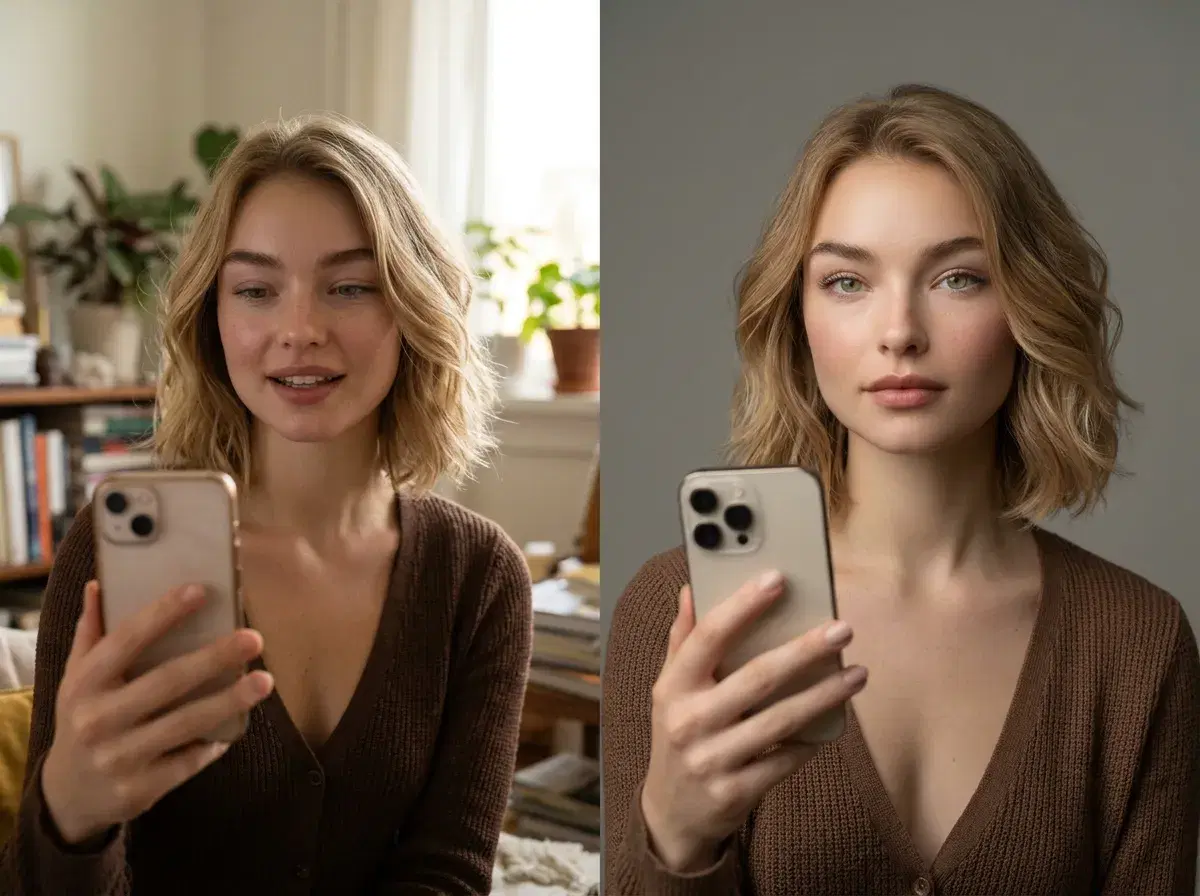
The question brands ask about AI influencers is usually framed as a cost comparison, and on cost it is not close — generating a persona's content for a week costs less than most single sponsored posts. But the comparison only becomes useful once you notice that the two things are not substitutes for each other.
A human influencer sells access to an audience that already trusts them. A generated persona sells production capacity. This is a straight look at cost, control, and scale, and where each one genuinely wins.
The persona side runs on Pose AI video generation.
- Cost: a generated persona runs on a weekly subscription; a human influencer charges per post or per campaign, and rates scale with their following.
- Control: total with AI — the face never has an off day, never goes off-message, and never posts something you have to answer for.
- Scalability: a persona can produce a week of content in an afternoon and appear in ten market variants at once.
- What AI cannot buy: an existing audience and the trust that comes with it. That is the actual product a real influencer sells.
- Most brands doing this well use both — generated content for volume and variants, human creators for reach and credibility.
Cost
Human influencer rates vary enormously by follower count, niche, engagement, and market — a nano-creator might charge a couple of hundred dollars for a post while a large account runs into five figures, and those are broad ranges rather than quotes. Add production time, negotiation, contracts, and usage rights, and the true cost of a campaign is higher than the headline fee.
A generated persona has a different cost shape entirely: a flat subscription plus the time to produce. Pose is $4.99 the first week, then $14.99 a week with 400 credits covering images, video, and voice, so the marginal cost of another variant is close to zero. What you are actually buying is production capacity, not reach.
Control
This is where AI wins most decisively and least controversially. A generated persona wears exactly what you specify, says exactly what the script says, appears in exactly the setting you describe, and is available at 2am on a deadline. It does not have a bad week, an unrelated controversy, or a competing sponsorship.
The flip side is that control is also the limitation. Human creators are worth their fee partly because they are not controllable — their taste, their voice, and their willingness to say something a brand would not have written is exactly what their audience turns up for. Perfect message discipline reads as advertising, because it is.
Scalability
A persona scales along axes a person cannot. The same identity-locked character can appear in twenty creative variants for testing, in several language versions with a cloned voice, and across a full content calendar produced in a single session — all without a shoot, a schedule, or a location.
For performance marketing that is a real structural advantage: creative testing is bottlenecked by how many variants you can produce, and generated content removes that bottleneck. It does not, however, remove the need for someone to decide which variants are worth making.
AI influencer vs real influencer
| Factor | AI influencer (Pose) | Real influencer |
|---|---|---|
| Cost model | Flat weekly subscription, near-zero marginal cost per asset | Per post or per campaign, scaling with audience size |
| Existing audience | None — you build it from zero | The whole point: reach and established trust |
| Creative control | Total: wardrobe, setting, script, timing | Shared — and their independence is part of the value |
| Output volume | A week of content in an afternoon; many variants at once | Limited by their schedule and their audience's tolerance |
| Brand safety | No off-platform behaviour to manage | Managed through contracts and vetting |
| Authenticity | Requires disclosure; audiences discount synthetic endorsement | A genuine personal recommendation, which is what converts |
Read the last two rows together. AI removes one brand-safety risk — the human one — and introduces another: an audience that feels sold to by something that was never a person. Real influencers win the rows that decide whether a recommendation lands; AI wins the rows that decide how much you can produce and test.
Explore AI influencer story photo styles to see the persona side in practice.
See Pose AI pricing for what a week of production actually costs.