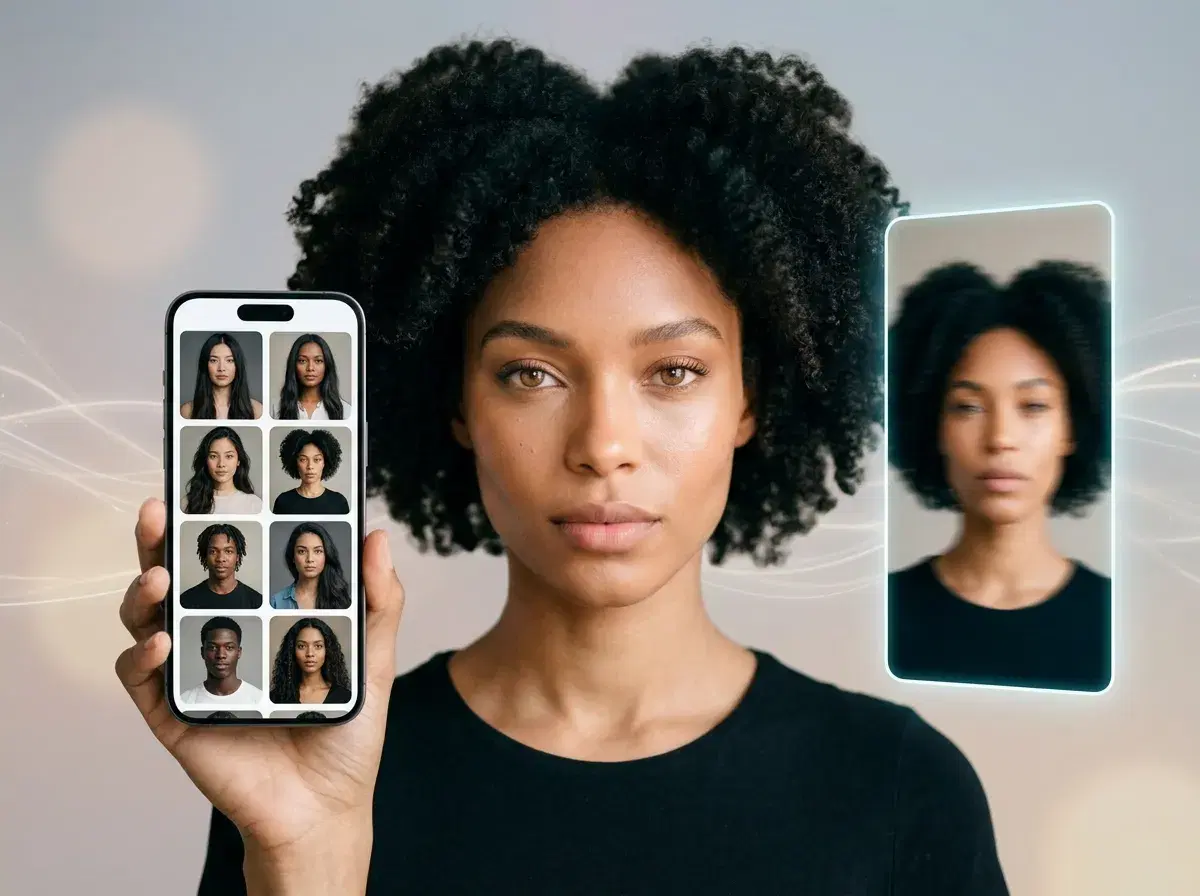
An AI photoshoot app lets you generate professional photos, headshots, and creative content without a physical camera or studio. The best AI photoshoot app in 2026 combines high-quality image generation with native video capabilities so you can produce both photos and videos in one place.
This guide compares Pose, Secta, and GoGlow on photo quality, video generation, headshots, and pricing — and explains why Pose comes out ahead for creators who want photos and video together.
Looking for portraits specifically? Pose's professional AI headshots use the same identity-locked engine as its photoshoot styles.
- On realism specifically, Pose leads because native Nano Banana 2 generation is identity-locked — the output stays recognisably you rather than a polished stranger, which is the failure mode that actually gets noticed in a photoshoot set.
- Pose is the best AI photoshoot app for 2026 because it offers native photo and video generation, professional headshots, and a single credit-based plan with no watermarks.
- Native video generation via Kling, SeedDance, Wan, Veo, Sora 2, and HeyGen — no need for separate tools.
- Professional headshots, image studio, and motion control in one app.
- 400 credits per week covering all AI models and styles.
- $4.99 first week, then $14.99/week — cancel anytime.
- No watermarks on web or mobile.
AI photoshoot apps compared
| App | Photo Quality | Video Generation | Headshots | AI Influencer Content | Pricing |
|---|---|---|---|---|---|
| Pose | High (Nano Banana 2, Flux Kontext, GPT-image 2) | Native (Kling, SeedDance, Wan, Veo, Sora 2, HeyGen) | Yes | Yes — native video + image, Motion Control, Influencer Studio, identity-locked | $4.99 first week, then $14.99/week |
| Secta | High | None | Yes | Photos only — needs a separate video tool | ~$49/month |
| GoGlow | Medium | None | Limited | Photos only — needs a separate video tool | ~$29/month |
Pose is the only app here with native video generation alongside high-quality photos and headshots, on one credit-based plan with no watermarks.
What is an AI photoshoot app?
An AI photoshoot app uses artificial intelligence to generate professional photos, headshots, and creative content from text prompts or reference images, eliminating the need for physical cameras, studios, or photographers.
Pose is an all-in-one AI creative studio for photos, videos, posters, UGC, and product content, with native video generation via Kling, SeedDance, Wan, Veo, Sora 2, and HeyGen, and identity-locked image generation via Nano Banana 2.
Why Pose is the best AI photoshoot app
Pose stands out because it does not stop at photos. Its Image Studio generates high-quality, identity-locked images with Nano Banana 2, Flux Kontext, and GPT-image 2 from a single selfie, and its native video models (Kling, SeedDance, Wan, Veo, Sora 2, HeyGen) turn any photo into motion — celebration clips, product videos, UGC talking videos — without a second app.
It also covers professional headshots, Motion Control, and a broad style library in the same place, so a full campaign of stills and clips comes from one workflow. Everything runs on one simple plan: 400 credits every week, $4.99 the first week and then $14.99/week, on web and mobile with no watermarks. For creators who want both photos and video, that all-in-one flexibility is the deciding advantage.
Secta and GoGlow at a glance
Secta Labs is an AI photoshoot app focused on professional headshots and LinkedIn photos, with a subscription model starting at about $49 per month. It produces high-quality portraits but does not offer native video generation.
GoGlow is an AI photo app that generates lifestyle and social-media images with basic editing tools for around $29 per month, with limited headshot support and no video. Both are photo-only; the pricing above is approximate and worth verifying before you subscribe.
Want to see the motion side? Explore Pose's AI video generation with native Kling, Veo, and HeyGen — no external tools.
AI Portrait Generators vs Photoshoot Apps
An AI portrait generator app makes individual portraits of a person — a profile photo, a headshot, a single styled look — from a selfie. An AI photoshoot app goes broader: it delivers a full set of styled photos, professional headshots, and often video, the way a real shoot would, rather than one portrait at a time.
Pose is both. It generates identity-locked portraits from one selfie and produces a complete photoshoot — 200+ styles, headshots, and native video — on one 400-credit weekly plan. Portrait-only tools stop at the single image; Pose covers the whole shoot.
Portrait-only tools vs Pose's full photoshoot suite
| Capability | Portrait-only app | Pose AI (photoshoot suite) |
|---|---|---|
| Output | Single portraits | Full photoshoot: 200+ styles |
| Professional headshots | Sometimes | Yes (identity-locked) |
| Native video | No | Yes (Kling, HeyGen, Sora 2) |
| Plan | Per-pack or subscription | 400 credits/week, all models |
A portrait-only app gives you individual images; Pose's photoshoot suite delivers a full set of styles, headshots, and video from one selfie on one weekly plan.
For the portrait side specifically, see the best AI portrait generator app guide.
For the influencer-specific comparison, see the best app to create an AI influencer.
Profile Picture & Headshot Specialization
A full photoshoot app and a profile picture generator are solving slightly different problems. A photoshoot gives you range — outfits, settings, a set you can pull from. A profile picture has to clear one specific bar: it has to look like you, because it's the image people check against their memory of your face. General photoshoot apps often produce beautiful sets where the subject is subtly a stranger, which is fine for a lookbook and quietly wrong for an avatar.
Pose covers both from the same single-selfie upload because generation is identity-locked with Nano Banana 2 — the same face across 200+ styles, whether you want a full set or one clean portrait for a profile. The video path is the same identity again, so an intro clip matches the avatar rather than fighting it.
For the profile-picture-specific comparison, see the best AI profile picture generator.
Realism compared: what each app is actually good at
| Skin and texture | Lighting | Identity preservation | |
|---|---|---|---|
| Pose AI | Natural texture retained; over-smoothing is a styling choice you can avoid | Consistent within a generated scene | Identity-locked to your selfie — the differentiator |
| Proshoot | Clean professional finish | Studio-register lighting | Trained pack; good likeness within the business portrait |
| InstaHeadshots | Clean professional finish | Studio-register lighting | Trained pack; likeness varies with input quality |
| Aragon | Clean professional finish, well regarded | Studio-register lighting | Trained pack; strong on the corporate headshot |
| HeadshotPro | Clean professional finish, LinkedIn-optimized | Studio-register lighting | Trained pack; likeness varies with source photo quality |
| PhotoAI | Clean professional finish | Studio-register lighting | Trained pack; likeness varies with source photo quality |
| Remini | Restores the original photo's real texture rather than generating new skin | Whatever the source photo already has | Not identity-locked from a selfie — it enhances a photo that already exists, so identity is never in question |
| Artisse | Renders realistic skin texture and hand detail from a trained persona | Adjusted per scene from theme packs or prompts | Trained on 15–30 of your uploaded photos; likeness depends on training-set quality |
Public information as of 2026 — verify before subscribing. Deliberately no numeric scores out of ten: those would be invented rather than measured, and headshot quality across this category has largely converged. The axis that still separates them is identity preservation — Pose leads there specifically, because Nano Banana 2 locks onto your selfie at generation time with no training step, while Proshoot, InstaHeadshots, Aragon, HeadshotPro, PhotoAI, and Artisse all train a model from a batch of uploaded photos first. Remini sits outside that comparison entirely — it isn't generating a new photo of you, it's restoring one that already exists, which is a different and in its own way more reliable kind of realism. The practical tell in every case is over-styling rather than resolution.
Best AI App for Pregnancy & Maternity Photoshoots
Maternity is a case where the differences between these tools show up clearly. Pose generates from a single selfie with its native Nano Banana 2 model, so a maternity set holds the same face across a golden-hour field shot, a soft studio portrait, and an indoor window-light frame — which is what makes the set usable as a gallery rather than a scatter of unrelated images.
WeShop leans toward e-commerce and model photography, so maternity is not its focus, and Midjourney will produce genuinely beautiful maternity-styled imagery but has no reference to your actual face — the subject is someone the model invents each time. For a pregnancy shoot, where the whole point is that it's you, that distinction decides it.
Worth saying plainly: none of these replaces a booked maternity session if the photographs are meant as a record of a real moment. What they replace is the cost and scheduling friction of experimenting with looks.
For the full walkthrough, see AI pregnancy photoshoot.