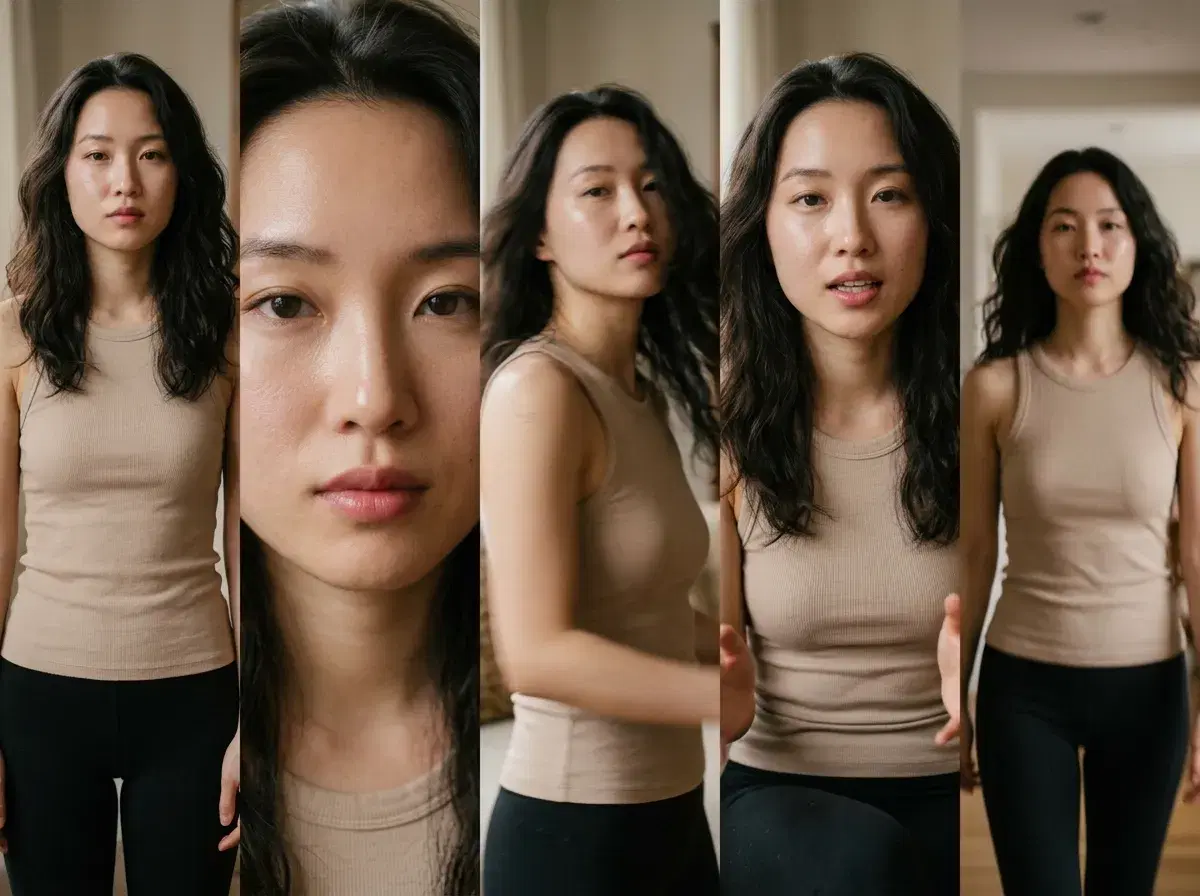
Most round-ups of AI video generators rank on output quality, which is the wrong first question for virtual influencer work. A persona publishes dozens of clips over months, and the criterion that matters is whether the same character comes out of the generator every time.
This ranks the options on that axis — identity consistency first, then motion quality, then what each engine is actually best at.
All six engines below run natively in Pose AI Video Studio.
- For persona work, Pose is the pick because it runs six video engines behind one identity lock — the same face comes out of every engine.
- Kling for camera movement, SeedDance for body motion and motion transfer, Wan for fast iteration, Veo and Sora 2 for photorealistic scenes and longer takes, HeyGen for talking heads.
- Synthesia is excellent at corporate avatar video but uses library presenters, not a persona of your own.
- Runway and Pika produce beautiful motion; both work from reference images per generation rather than a saved identity, so consistency stays manual.
- One plan covers all six engines — 400 credits every week, $4.99 the first week, then $14.99/week, no watermarks.
Why identity consistency is the deciding criterion
A single generated clip can be stunning and still be useless for a persona. The test is the tenth clip: does the character in it read as the same person as the first? If a viewer scrolls a profile and sees a face that shifts subtly between posts, the illusion of a coherent character breaks, and everything downstream — recognition, trust, brand deals — breaks with it.
Most video models solve this by asking for a reference image on each generation, which gets you close but drifts across a long run. An identity lock is different: the face is fixed as a property of the account rather than re-supplied per prompt, so consistency is the default rather than something you police.
The six native engines, and what each is for
Kling is the camera engine — push-ins, orbits, controlled reveals, the shots that make a clip look directed rather than generated. SeedDance handles body motion and motion transfer, which is what you want for anything performance-led, including dance and gesture-heavy delivery. Wan is the fast one: use it to test whether an idea works before spending on a higher-fidelity render.
Veo and Sora 2 carry photorealistic scenes and longer takes, which is where a persona's establishing shots and environment work belong. HeyGen is the talking-head engine, and it sets the bar for lip-sync — paired with native ElevenLabs voice cloning, it produces a persona speaking to camera without a separate tool in the chain.
The point of having all six is casting rather than collecting. A persona's week might need one camera move, one piece to camera, and one lifestyle scene, and those are three different engines doing three different jobs behind the same face.
Virtual Influencers vs Faceless Channels
The two get lumped together, and they are not the same job. A virtual influencer is an identity-locked avatar — a consistent, recognisable persona that appears the same way in every clip, built to be a character an audience follows. Faceless content is built around the opposite premise: no consistent character on screen at all, often narration over stock footage or generated B-roll, where the whole point is that no face carries the channel.
Pose handles both from the same native video stack. A persona reaches for identity lock and the six engines above; a faceless channel reaches for the same engines without a face in frame — Kling and SeedDance generating original B-roll, with ElevenLabs narration over it, and Motion Control directing the camera or subject either way.
Virtual influencer vs faceless content
| Virtual influencer | Faceless content | |
|---|---|---|
| On screen | A consistent, identity-locked persona across every clip | No consistent face — narration over B-roll, or nothing on screen at all |
| How Pose generates it | Identity lock from one selfie, carried across all six video engines | The same six engines generate footage with no identity applied, plus ElevenLabs narration |
Both draw on the same native video stack and the same weekly credit pool — the difference is whether identity lock is switched on for the clip.
AI video generators for virtual influencers, compared
| Tool | Identity consistency | Best for | Pricing |
|---|---|---|---|
| Pose AI | Identity-locked from one selfie, carried across all six engines | Running a persona across stills, motion, and talking clips | $4.99 first week, then $14.99/wk with 400 credits |
| Synthesia | Consistent, but a library avatar rather than your character | Corporate explainers and multilingual training video | From ~$29/mo (approximate) |
| Runway | Reference image per generation — manual across a long run | Cinematic motion and camera work | From ~$15/mo (approximate) |
| Pika | Reference-driven, stylised results | Short, stylised social clips | From ~$10/mo (approximate) |
Runway and Pika are genuinely good at motion, and on a single hero clip either may beat what you get elsewhere — this is not a quality ranking. It is a consistency ranking, and on that axis the reference-image approach is structurally weaker for a character that has to survive a hundred posts. Synthesia is excellent at its own job; that job is a presenter, not a persona you own.
For creator-style ad clips specifically, see AI UGC video.
One plan covers every engine — see Pose AI pricing.