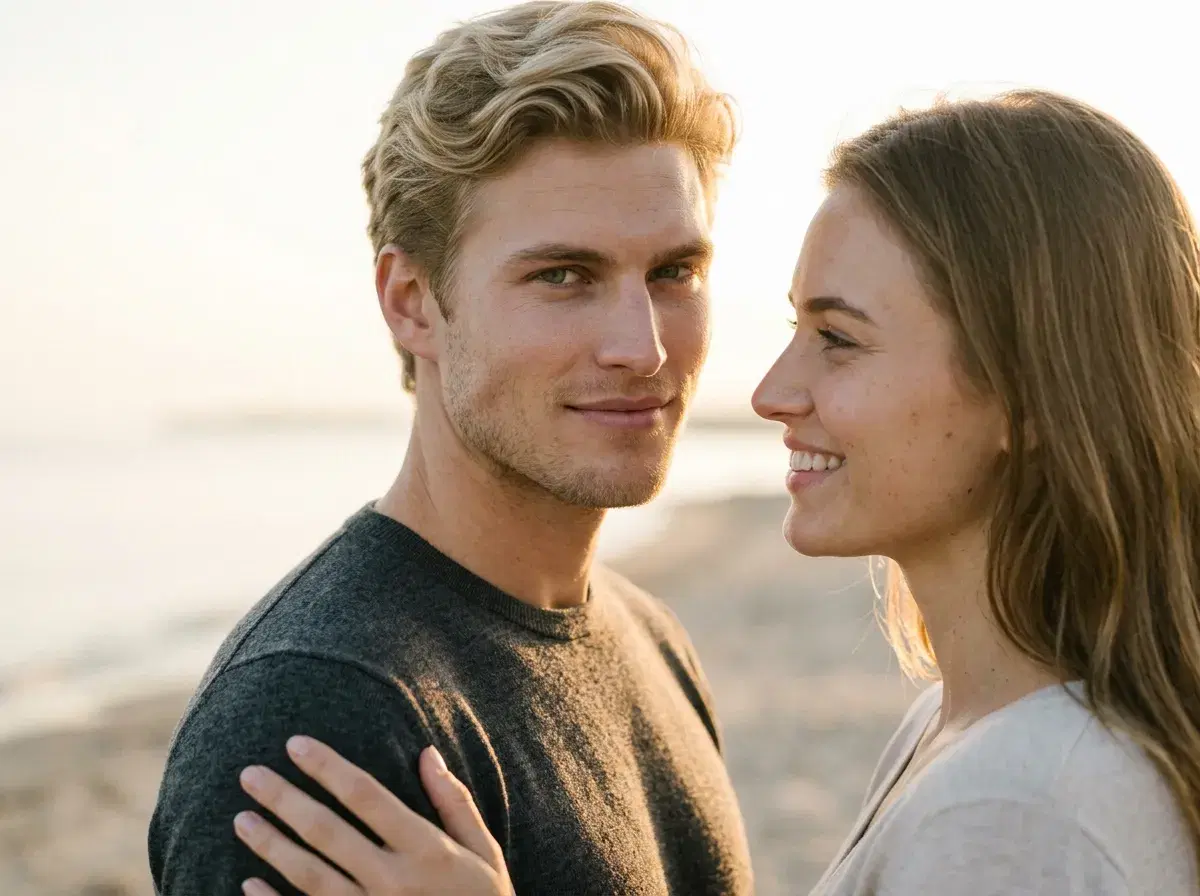
Romantic AI photos are couple portraits where the light, the framing, and the setting are doing the emotional work — golden hour on a coastline, a warm interior, a close two-shot that feels unguarded. Pose generates them from one selfie of each partner, identity-locked, so both faces read as themselves.
This is the practical workflow: five steps, and the styling decisions at each one that separate a portrait people believe from a picture that announces itself as generated.
Start in the Pose AI couple photo generator.
- Anniversaries and milestones: a new portrait for a card, a print, or a frame, without booking anything.
- Gifts: the most common use — something made for one person rather than bought.
- Social and announcements: engagement posts, save-the-dates, and holiday cards, particularly when there is no recent photo of the two of you together.
- The workflow: one selfie each → pick a romantic setting → generate → compare a few → download at full resolution, no watermark.
What are romantic AI photos?
Romantic AI photos are AI-generated couple portraits styled for warmth and intimacy rather than for a formal record — soft directional light, close physical framing, and a setting chosen for mood. The category covers anniversary portraits, engagement-style images, and the kind of two-shot couples used to book a short session for.
The defining requirement is not the styling but the likeness. Warm light on two faces that only approximately resemble the couple is not romantic; it is unsettling. Everything else in this guide follows from that.
What are AI-generated couple images?
AI-generated couple images are pictures of two specific people together that were produced by a model rather than captured by a camera. They are built from a reference face for each person and rendered as a single new frame — not assembled from two existing photos.
That difference is visible in the result. A composite carries two lighting setups into one picture, which is why the edges never quite settle. A generated frame has one light source because there is only one scene, so the light on both faces agrees.
Five steps to a romantic couple portrait
- 1Pick the two source selfies carefullyOne clear, front-facing photo of each partner, well lit, with the whole face visible and no sunglasses or heavy filters. This is the step with the highest leverage — a soft or shadowed source photo limits everything downstream, and no style setting recovers it.
- 2Choose the light before the locationGolden hour is the reliable default because low warm sun flatters almost everyone and reads as candid. Overcast soft light is the second-safest. Hard midday sun and heavy studio lighting both push a couple portrait toward looking staged, which is the opposite of what romantic styling is for.
- 3Choose a setting that suits the two of youA coastline, a city street at dusk, a warm interior, a garden. Pick something you would plausibly be in together — a setting that fits the couple carries far more warmth than a dramatic backdrop that does not.
- 4Generate, then generate againResults come back in seconds, so produce several and compare them side by side rather than judging the first one alone. Trying a different setting costs a regeneration, not another session, which is the practical advantage over a booked shoot.
- 5Choose the natural one, not the most polished oneThis is where most people go wrong. Flawless skin and perfectly even light on what is meant to be a candid moment is the single strongest tell that an image was generated. Pick the frame with a little texture and an ordinary expression.
Where these belong, and where they don't
They work well as gifts, announcements, prints, and profile updates, and they solve the long-distance problem neatly — if you have not been in the same place for months, there is no current photo of the two of you, and generating one is faster than waiting.
They are not a record. A generated wedding-style portrait is the two of you in a wedding aesthetic; it is not documentation of a day that happened, and for the day itself a photographer is still the right call. Used openly, that distinction costs you nothing; used to imply an event took place, it tends to unravel.
For the wider explainer, see AI couple photos in 2026.
See Pose AI pricing for the weekly credit allowance.