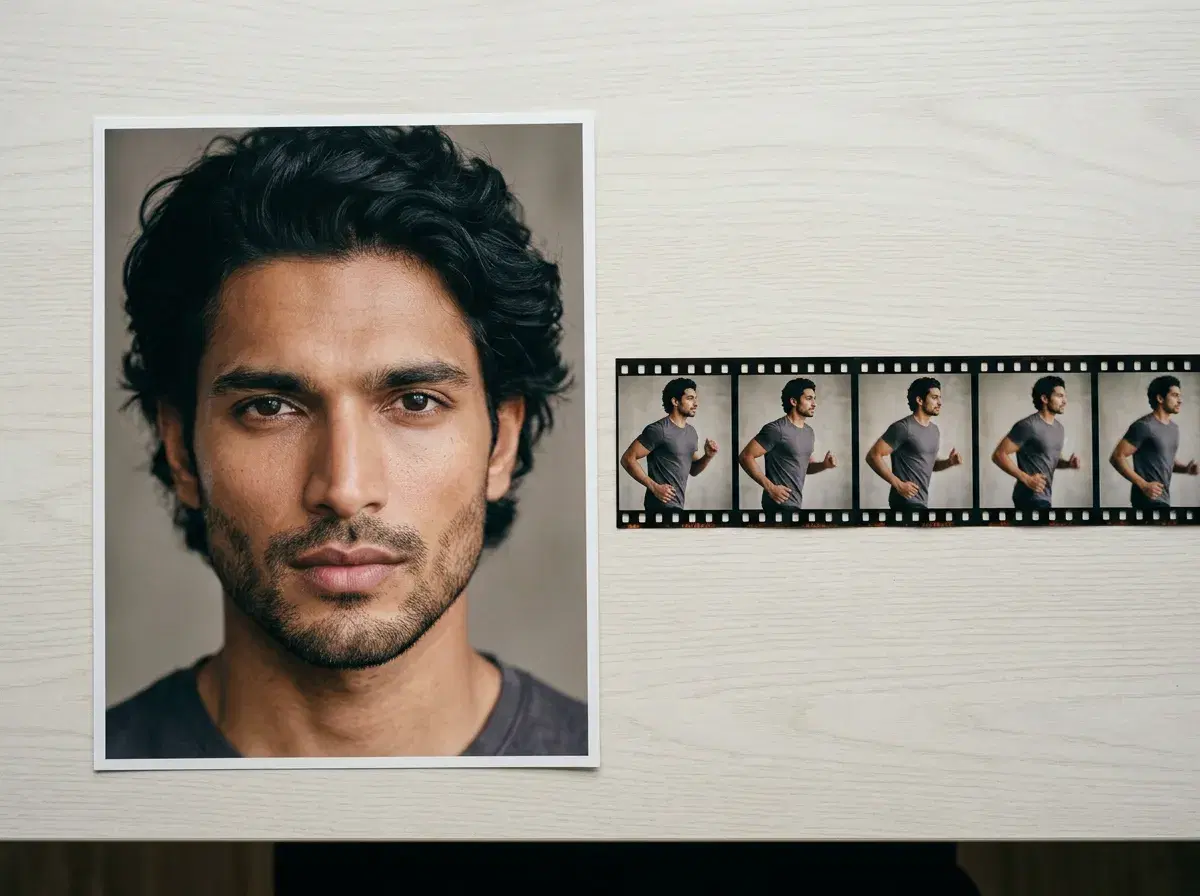
"Photorealistic" is used loosely enough that it has stopped meaning much on its own. Underneath it are three things that can actually be checked: whether skin looks like skin, whether light behaves consistently, and whether motion has real physics.
This walks through what each of those means, then benchmarks six models — three for photos, three for video — on the axes that apply to them.
Try the models described here in the Pose AI Video Studio.
- Skin texture is a photo-model metric: pores, fine hair, uneven tone and micro-imperfections, as opposed to the smoothed, plastic look that gives generated skin away.
- Lighting consistency matters for both photos and video: does light fall on the subject and the scene from one coherent source, and does it hold steady across a moving clip.
- Motion physics is a video-only metric: weight, momentum and the way a camera or a body moves believably rather than floating.
- Nano Banana 2 (Pose's native photo model) leads on skin texture and identity lock. Kling and Veo lead on motion and scene realism, with Sora 2 strongest on longer coherent takes. HeyGen leads specifically on lip-sync and delivery for talking-head video.
What makes AI output look realistic
Skin texture is the fastest tell in a still image. Real skin has pores, faint colour variation, small blemishes and hair that does not sit perfectly — a model that smooths all of that away produces a face that reads as generated at a glance, regardless of resolution.
Lighting consistency is about whether one light source explains everything in the frame. A face lit from the left while the background implies light from the right is the kind of mismatch a viewer notices without being able to say why.
Motion physics only applies to video: does a camera move the way a camera moves, does fabric and hair carry weight, does a gesture land with the right timing. This is where video models diverge most sharply from each other and from photo models entirely.
Six models benchmarked
| Model | Type | Strongest at |
|---|---|---|
| Nano Banana 2 | Photo (native in Pose) | Skin texture and identity lock |
| Flux Kontext | Photo (native in Pose) | Scene and lighting coherence |
| Kling | Video (native in Pose) | Camera movement and cinematic motion |
| Veo | Video (native in Pose) | Photoreal scene lighting across a moving shot |
| SeedDance | Video (native in Pose) | Subject motion and how a body moves |
| HeyGen | Video (native in Pose) | Lip-sync accuracy for talking-head delivery |
This is a qualitative benchmark, not a numeric score — collapsing skin texture, lighting and motion into one number would imply a precision that was not actually measured. All six models are native inside the Pose Video and Image Studios, on one weekly credit pool.
Why photo and video realism are not the same problem
A photo model only has to get one instant right. A video model has to get that instant right and then keep it right across every subsequent frame, which is why motion is where video realism actually fails — a single frame can look perfect and the clip can still read as generated because a hand moves without weight or a camera pans without the small imperfections a real camera has.
That is also why casting the right engine to the shot matters more than picking one favourite model. Kling for camera movement, SeedDance for a body in motion, Veo for a wider photoreal scene, HeyGen when a face needs to speak convincingly — Pose's native video engines cover different failure modes rather than competing head to head.
For identity-locked photo generation specifically, see AI headshots.
Plans and weekly credits are on the pricing page.